
Marine audio has a narrow margin for error, because salt air, spray, glare, and rough handling expose weak hardware fast. The strongest choices here balance weather tolerance, clear controls, and simple source options for dock days, weekend runs, and long stretches offshore.
These seven units cover different setups, from compact single-DIN receivers to gauge-style dash units and a package with speakers. The right match depends on dash space, source flexibility, and how much you want integrated versus modular audio.
Quick Shortlist For Fast Comparison

Sony DSXM55BT Bluetooth Marine Digital Media Stereo Receiver
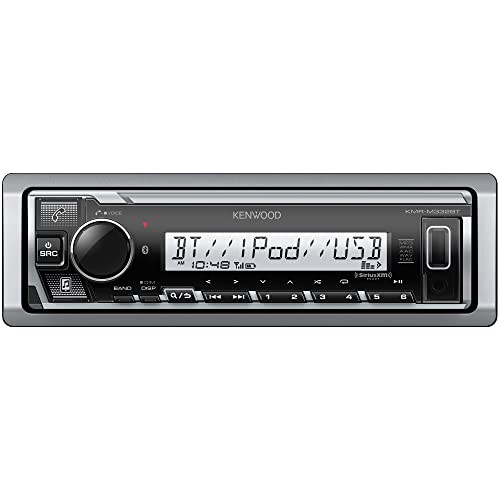
KENWOOD KMR-M332BT Car & Marine Stereo Single Din

Kicker 46KMC2 Gauge-Style Media Center with Bluetooth

Pyle Marine Radio Single DIN Receiver

BOSS Audio Systems MCK632WB.6 Marine Bluetooth Stereo

Pioneer MVH-S110BT 1-Din Digital Media Car Stereo

KENWOOD KMR-D382BT Single Din Car/Marine Stereo Head Unit
More Details On Our Top Picks
Single-DIN marine dashboards often need a receiver that stays straightforward, and this Sony keeps the layout restrained. SiriusXM Ready support adds source flexibility for boats that split time between local radio and streamed audio, while the digital media design skips the extra bulk of a disc slot.
That lean format suits weekend cruisers, older hulls with tighter cutouts, and refits where the goal is tidy function rather than a crowded front panel. The trade-off is simple, there’s no built-in CD section, so owners who still keep discs in the cabin should look farther down the list.
Strong Points
- Single-DIN footprint fits common marine openings without turning the dash into a puzzle.
- Bluetooth streaming keeps phone playback and calls in one place.
- SiriusXM Ready support broadens listening choices for long stretches on the water.
- Digital-media format leaves less clutter on the faceplate, which helps in cramped helm layouts.
Points To Note
- No CD section, so legacy disc collections stay out of the equation.
- Owners who want onboard source variety may prefer a model with USB and auxiliary inputs spelled out more fully.
Feature Snapshot
Who It Suits Best
Boat owners with a standard single-DIN opening and a streaming-first listening habit stand to gain the most here.
A Better Fit Elsewhere
KENWOOD KMR-D382BT suits cabin setups that still need a CD player, plus a broader set of physical source options.
This Kenwood lands in the practical middle ground, with Bluetooth, USB, auxiliary input, AM/FM radio, and SiriusXM Ready support in one single-DIN unit. Weatherproofing and multicolor illumination round out the package, which helps on boats that see both bright daylight and low-light evening use.
It suits owners who want one receiver to handle streaming, flash drives, and the radio without piecing together extras. Compared with the Sony DSXM55BT, this model adds a more explicit spread of source inputs, though the face is busier and that can matter in a small helm.
What We Like
- Bluetooth, USB, aux, and radio support cover a broad listening mix.
- Weatherproof construction suits marine environments better than basic car-only units.
- Multicolor illumination helps the display blend with different dash styles.
- SiriusXM Ready support keeps satellite radio in play for long runs.
- Single-DIN sizing stays friendly to many retrofit installs.
Small Caveats
- The fuller front panel can feel visually busy in very compact dashboards.
- Multicolor lighting is useful, though it adds one more setting to manage during installation.
Core Details
Who Will Love This
Weekend boaters who want several source choices in a straightforward single-DIN format are the clearest match.
Another Choice May Suit
Pioneer MVH-S110BT fits a cleaner, media-first setup for dash spaces that do not need the wider source list.
Open helm boats need gear that stays readable and compact, and the Kicker 46KMC2 is built around that reality. The gauge-style form factor, rotary encoder, and included USB and RCA inputs make it feel purpose-built for a tight dash where space is limited and controls need to stay easy to reach.
Its IPX66 rating matters for exposed locations, since that level of protection is designed for heavy splash exposure and strong water jets. The honest read is that this model makes the most sense in a boat-first setup, while land-based installs may find the round dash fit less convenient than a standard single-DIN receiver like the Sony or Kenwood.
Highlights
- Gauge-style layout is well suited to open helms and compact marine panels.
- Rotary encoder gives a simple control feel, even with wet or moving hands nearby.
- USB, RCA, Bluetooth, and AM/FM support add useful source flexibility.
- Over 200 watts of total peak output across four channels gives it a stronger amp figure than the smaller entry picks.
- IPX66 protection is a strong fit for exposed watercraft use.
Areas To Watch
- The round gauge opening is specific, so install compatibility needs a closer look than a standard DIN unit.
- Boat-first design makes it less adaptable for mixed car-and-marine use.
Details At A Glance
Built With In Mind
Open-helm boat owners and compact-dash installers who need a round, weather-tolerant media center will get the clearest fit here.
Swap It Out When
KENWOOD KMR-M332BT is the more flexible route for standard rectangular dash openings and a broader car-and-marine mix.
Pyle keeps the formula familiar, which is often the right move for a refit that needs Bluetooth, radio, and simple playback options without extra complexity. Hands-free calling and the included remote control make it easier to manage from the helm or cabin, while RGB button lighting helps the face stay legible at night.
Compared with the Kenwood and Sony units, this one leans more toward straightforward function than polished brand depth, and that can suit modest boat upgrades well. Splash resistance adds confidence for marine use, though owners who want a more premium-feeling control layout may still prefer the Kicker or one of the Kenwood models.
Best Bits
- Bluetooth streaming and AM/FM tuning cover the basics without clutter.
- USB and aux playback offer simple paths for portable audio.
- Hands-free calling and a remote bring easier day-to-day control.
- RGB button lighting helps the panel stay visible after dark.
- Splash-resistant construction fits casual marine installations well.
Minor Gripes
- Feature depth is narrower than the more source-heavy Kenwood units.
- Remote-based use can feel less direct than a larger rotary-control design.
- Basic marine upgrades may outgrow it faster than a more expandable receiver.
Feature Card
Right Fit For
Casual boat owners seeking a budget-conscious receiver with the right basics and a simple install path are the clearest match.
A Better Fit Elsewhere
BOSS Audio Systems MCK632WB.6 suits shoppers who want a bundled stereo-and-speaker setup instead of a receiver-only replacement.
This BOSS bundle stands out for a reason that matters in small boats, because the stereo and 6.5-inch speakers arrive together. The detachable front panel adds a bit of practical security, while the included dipole antenna and multicolor illumination make the package feel more complete than a bare receiver swap.
That bundled approach helps first-time marine installers or anyone refreshing a starter boat without piecing together parts one by one. The trade-off is obvious, the system is less flexible than a standalone head unit paired with separately chosen speakers, which matters for custom audio layouts.
Positives
- Receiver and speakers arrive as one package, which simplifies planning.
- USB and aux inputs keep portable playback within easy reach.
- Detachable faceplate adds a practical layer for storage in dockside use.
- 50W x 4 output gives a stronger stated power figure than the smaller basic units.
- Included dipole antenna reduces the need to source another core part separately.
Room For Improvement
- Bundled speakers limit component-by-component customization.
- Installation can take more planning than a simple receiver-only swap.
- Some setups may prefer a dedicated marine speaker pair with a higher-grade head unit.
Spec Overview
Whose Shelf It Belongs On
Starter-boat owners and practical refit shoppers who want a bundled audio package are the best match here.
Look Elsewhere When
Pioneer MVH-S110BT is the cleaner choice for a compact receiver-only install with less bundle complexity.
Pioneer takes a stripped-back route here, and that works well in marine spaces where simplicity keeps the dash easy to live with. The unit uses a digital media format, includes a USB input, and lists 50W x 4 output alongside AM/FM support, plus compatibility with iPhone and Android devices.
That makes it a sensible choice for owners who stream most of the time and do not want extra source clutter. The lack of a disc section is deliberate, not a flaw, though mixed-media households may lean toward the Kenwood KMR-D382BT for its CD support and broader source spread.
Bright Spots
- Digital media layout keeps the front panel clean and direct.
- USB input gives a dependable wired playback route.
- 50W x 4 output is a solid stated amp figure for the class.
- iPhone and Android compatibility helps make phone pairing more straightforward.
- Front and SW RCA outputs add flexibility for external amplifier plans.
Softer Spots
- No CD player, so disc-based listening is outside the setup.
- The media-first design may feel too spare for owners who want more front-panel controls.
- Marine use still calls for careful installation and sealing around the dash opening.
Technical Sheet
The Right Fit
Streaming-focused boat owners who want a compact, no-nonsense receiver with external-output flexibility are the best match.
Where A Sibling Pick Shines
KENWOOD KMR-D382BT suits mixed-media setups better, especially where a CD player still matters.
KENWOOD’s KMR-D382BT gives the category a more traditional path, with Bluetooth, hands-free calling, a CD player, USB, AM/FM radio, and SiriusXM Ready support all in one single-DIN body. The all-weather in-dash design suits boats and cars alike, which makes it useful for owners who split time between a truck, cabin, or utility vehicle and the water.
That broader source mix is the headline, and it also explains why this model feels more substantial than the Pioneer MVH-S110BT. The trade-off is a busier feature set, so a minimalist helm may be happier with the simpler Sony or Pioneer units.
Upsides
- CD player adds a source type that several slimmer media receivers skip.
- Bluetooth and hands-free calling keep phone use more manageable at the helm.
- USB and AM/FM support widen day-to-day listening choices.
- SiriusXM Ready support helps with long-range or routine cruising.
- Car and marine compatibility gives it a useful crossover role.
Things To Consider
- The richer feature set can feel busy in a small, clean dashboard.
- Owners who only stream music may not need the CD hardware.
- As with any in-dash unit, seal quality around the opening matters in wet environments.
Core Details
Who Should Grab It
Mixed-use owners who still want a CD player and a wider source spread will get the most from this head unit.
Where Shoppers Go Wrong
Simple streaming-only setups usually do not need this much hardware, and the Sony DSXM55BT is the cleaner fit for those installs.
How To Choose The Right Marine Stereo Bluetooths
Fit, Source Support, And Front-Panel Layout
Dash size comes first, because a single-DIN opening, a gauge cutout, and a bundled stereo-speaker package solve different problems. The gauge-style Kicker 46KMC2 works where exposed helm space is tight, while the Sony, Kenwood, Pyle, Pioneer, and KENWOOD head units fit standard single-DIN spaces.
Source support matters just as much. Bluetooth covers streaming, but USB, aux, CD, AM/FM, and SiriusXM Ready support change how much flexibility a system offers on long trips or shared boats.
Marine Exposure And Control Style
Salt, spray, and glare punish cramped controls, so button size, lighting, and rotary knobs deserve real attention. The Kicker’s rotary encoder fits that use case well, and multicolor illumination on the Kenwood KMR-M332BT and Pyle can help in low light.
Weatherproof or splash-resistant construction makes sense for open decks and wet docks, yet the level of protection still varies by model. A boat that lives on a trailer has different needs from one that stays moored through rough weather.
Power, Speakers, And Expansion
Power output is only part of the story, but it helps frame speaker matchups. The BOSS bundle’s 50W x 4 rating and included 6.5-inch speakers suit simpler installs, while the Kicker’s over-200-watt peak figure points toward a more ambitious open-helm setup.
Front and subwoofer RCA outputs, found on the Pioneer, matter for anyone planning an external amp or later upgrades. That extra headroom costs more and takes more planning, but it makes sense for larger boats or owners who expect the audio system to grow.
Things Worth Knowing First
Common Shopping Slip Ups
Dash fit gets overlooked surprisingly often, especially when a gauge opening or an old rectangular slot is already in place. Source variety gets missed too, and that becomes obvious the first time a boat needs USB playback or a radio fallback beyond Bluetooth.
Cleaning and upkeep also matter. A faceplate with fewer seams and a sensible control layout is usually easier to keep tidy after a wet weekend on the water.
Why Top Tier Costs More
Higher-tier marine stereos usually pay for broader source support, stronger output figures, and designs built around harsher environments. The Kicker 46KMC2 and KENWOOD KMR-D382BT reflect that with more specific use-case coverage than the simplest media receivers.
Extra money also tends to go into layout and expandability. A receiver with RCA outputs, detachable panels, or an all-weather build solves more installation problems, which matters in boats that see frequent use.
Frequently Asked Questions
What makes a stereo suitable for marine use?
Weather-aware construction, simple controls, and a dash fit that matches the boat matter most. Open-helm boats usually benefit from tighter layouts and clearer screens.
Is Bluetooth enough for boat audio?
Bluetooth handles streaming well, but it is not the only source worth having. USB, AM/FM, and SiriusXM Ready support help when a phone battery drops or cell service disappears.
Do all of these units fit the same opening?
No, the list includes single-DIN receivers, a gauge-style unit, and a speaker bundle. Dash size and mount shape should guide the choice before features do.
Why choose a bundled stereo and speaker package?
A bundle simplifies the shopping and install process. That path works well for starter boats or refresh projects that need a complete audio reset.
What matters more, power output or source options?
Both matter, but for smaller boats source flexibility usually comes first. Larger setups get more value from stronger output and RCA expansion options.