

Marine stereo upgrades have a practical job, they need to handle spray, simplify phone audio, and stay readable in bright daylight without making the dash harder to live with. This roundup focuses on single-DIN receivers, gauge-style media centers, and bundle-style setups that fit different boats and different installation comfort levels.
Some are built for straightforward Bluetooth listening, while others add CD playback, rear camera input, or speaker packages. The right choice depends on dash space, how often music changes hands between phone and radio, and how much control belongs at the helm.
Quick Look At The Shortlist

Sony DSXM55BT Bluetooth Marine Digital Media Stereo Receiver
KENWOOD KMR-M332BT Car & Marine Stereo Single Din

Kicker 46KMC2 Weather-Resistant Gauge-Style Media Center

Pyle Marine Radio Single DIN Receiver

BOSS Audio Systems MCK632WB.6 Marine Bluetooth Stereo

KENWOOD KMR-D382BT Single Din Car/Marine Stereo Head Unit

JVC KD-X560BT Digital Media Car & Marine Bluetooth Receiver
More Details On Our Top Picks
Sony’s single-DIN format keeps the install straightforward in boats with a standard dash opening, and the media-focused layout suits owners who stream more than they spin discs. The SiriusXM-ready note matters for long runs, where satellite radio can feel steadier than phone service.
In a compact helm, the main draw is simplicity, not visual drama. The trade-off is the absence of the extra input spread found on fuller-featured units like the KENWOOD KMR-M332BT or KENWOOD KMR-D382BT.
What We Like
- Single-DIN sizing keeps retrofit planning simple.
- Bluetooth support handles phone audio without extra adapters.
- Digital-media focus suits streaming-first use.
- SiriusXM readiness adds another source path for open-water trips.
Small Caveats
- No built-in CD player for disc-heavy libraries.
- Feature set stays more restrained than the KENWOOD pair.
Core Details
Who It Suits Best
Boat owners who want a straightforward, streaming-friendly receiver with a standard dash footprint stand to gain the most.
A Better Fit Elsewhere
The Kicker 46KMC2 suits open-helm boats that need a gauge-style mount, while this Sony fits conventional single-DIN openings better.
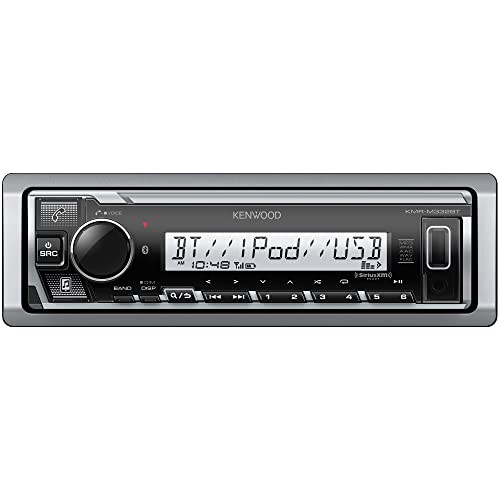
This KENWOOD broadens the source mix more than the Sony, with Bluetooth, USB MP3 playback, an aux input, AM/FM radio, and SiriusXM readiness in a single-DIN shell. That makes it a tidy fit for boats where different passengers bring different music habits, and some still keep tracks on a thumb drive.
Weatherproofing is the practical hook here, especially for boats that live in damp storage or see regular spray near the helm. The multi-color illumination adds legibility and a little dash personality, though the look stays functional rather than flashy.
Strong Points
- Multiple source options reduce format friction on longer outings.
- USB and aux inputs help with older devices and offline media.
- Weatherproof design suits marine mounting better than basic car units.
- Multi-color illumination can improve visibility in varied dash layouts.
- Single-DIN sizing keeps installation expectations familiar.
Points To Note
- The feature spread is broad, but the interface still depends on a compact face.
- Owners with a minimalist phone-only setup may not use every source option.
Feature Snapshot
Who Will Love This
Weekend boat owners who want more source flexibility than a basic Bluetooth deck should find this KENWOOD a sensible match.
Another Choice May Suit
The Sony DSXM55BT is the cleaner fit for a simpler setup, while this KENWOOD serves mixed media use more naturally.
The Kicker 46KMC2 speaks to open-helm boats first, because its gauge-style, round-dash design fits where a rectangular head unit can feel out of place. Its screen, rotary encoder, and claimed peak power across four channels point to a layout built for quick control with wet hands or rough motion nearby.
Bluetooth, USB, RCA, and AM/FM support cover the usual listening routes, so the hardware does more than look specialized. The honest read is that this makes the most sense where the dash already has a gauge opening and the helm needs a compact media center instead of a traditional stereo face.
Highlights
- Gauge-style form blends neatly into round dash openings.
- Rotary encoder gives direct, tactile control.
- Bluetooth, USB, RCA, and AM/FM support broaden source choices.
- IPX66 rating is a strong fit for exposed helm use.
- Compact layout suits boats with limited front-panel space.
Worth Noting
- Round-dash fit narrows the pool of boats it suits.
- Open-helm owners may need to plan mounting carefully around the gauge opening.
Details At A Glance
Best Suited To
Boats with round gauge openings and open helms are the natural match here, especially where space is tight and direct controls matter.
Look Elsewhere When
The Pyle Marine Radio Single DIN Receiver fits a standard rectangular dash more easily, while the Kicker is the cleaner answer for gauge-style installations.
Pyle keeps this one focused on the useful basics, with Bluetooth streaming, AM/FM tuning, USB and AUX playback, hands-free calling, and a remote control. RGB buttons add a little legibility and customization for darker helm setups, which helps more than decorative lighting usually does.
The splash-resistant housing makes sense on a boat that sees occasional spray but not full-on exposed mounting all day. Compared with the KENWOOD KMR-M332BT, it feels more pared back, though that restraint can suit a refit where cost and simplicity matter more than an extra source menu.
Best Bits
- Bluetooth and wired inputs cover everyday playback needs.
- Hands-free calling is useful for dockside coordination.
- Remote control adds convenience at a distance.
- RGB buttons improve visibility in low light.
- Single-DIN format helps with common marine dash replacements.
Areas To Watch
- Splash resistance is helpful, though not a substitute for careful mounting.
- Feature depth stays lighter than the KENWOOD and JVC units.
Feature Card
Right Fit For
Refits that need a sensible marine receiver with basic source flexibility and hands-free calling are the clearest match.
Swap It Out When
The BOSS Audio Systems MCK632WB.6 makes more sense for shoppers who want speakers bundled in the same package.
This BOSS package goes beyond the head unit by pairing the stereo with 6.5-inch speakers, so the purchase is aimed at faster system building rather than piecemeal upgrades. The detachable front panel helps with storage and basic security habits, while the included dipole antenna lowers the number of extra parts to source later.
The 50W x 4 output rating gives the deck a more muscular paper spec than the smaller source-only units in this list, though the actual setup still depends on the rest of the boat’s wiring and speaker layout. That makes it especially appealing for first-time marine audio refreshes, less so for owners who already have a speaker plan in place.
Strong Points
- Head unit and speakers arrive as a matched starting point.
- Detachable face helps with storage habits.
- USB and aux inputs support simple wired playback.
- Multicolor illumination helps the dashboard feel more legible.
- Included antenna trims the list of separate accessories.
Minor Gripes
- Bundle format may be more than some retrofits need.
- Owners with existing marine speakers may not use the full package value.
Key Specs
Whose Shelf It Belongs On
Owners starting from scratch, or replacing a tired full system, are the strongest fit because this bundle covers more of the audio chain.
Where A Sibling Pick Shines
The JVC KD-X560BT is the sharper choice for a feature-focused head unit with rear camera input, while this BOSS bundle leans into system-in-a-box convenience.
KENWOOD gives this unit a broader old-and-new media mix, because Bluetooth, a CD player, USB, AM/FM radio, and SiriusXM readiness all sit inside the same single-DIN frame. That kind of flexibility suits boats that still carry disc libraries or mixed media habits, and the 50W x 4Ch output spec gives the deck a stronger amplifier profile on paper.
Hands-free calling and all-weather in-dash labeling make the use case clear: a boat or car system that needs to be useful in more than one environment. Compared with the Sony and Pyle models, this one has a more traditional media footprint, which is exactly the appeal for owners who still keep CDs around.
Upsides
- CD playback remains available for disc libraries.
- Bluetooth and USB keep modern sources in play.
- Hands-free calling helps reduce phone handling at the helm.
- AM/FM and SiriusXM readiness broaden listening options.
- 50W x 4Ch output points to a stronger power profile.
Softer Spots
- Disc support adds value only for owners who still use CDs.
- The richer source mix may be more than casual streamers need.
Spec Overview
Made For
Owners who want a marine receiver with both disc support and modern streaming features will find the fit strongest here.
Reach For A Different Pick When
The Sony DSXM55BT is the lighter digital-media choice, while this KENWOOD suits mixed-format listening with more staying power.
JVC keeps the layout centered on practical digital media use, with iPhone, Android, USB, and AUX support joined by rear camera input. That last detail matters on boats where backing into a slip or tracking a trailer is part of the routine, because the head unit can serve more than music alone.
Compared with the Sony and Pyle units, this one is less about a broad radio story and more about everyday utility around a modern phone. The honest read is that it suits utility-minded installs better than nostalgic ones, and that focus gives it a clear place in the lineup.
Positives
- Rear camera input adds a useful second role for the display.
- Phone-friendly support covers common modern source devices.
- USB and AUX inputs keep wired playback simple.
- Digital-media format avoids unused disc hardware.
Room For Improvement
- Digital-media focus leaves out CD playback.
- Shoppers who rely on broadcast radio may prefer the KENWOOD models.
Core Details
Who Should Grab It
Boats that benefit from a rear camera input and a phone-first stereo layout are the natural match.
Skip It When
The KENWOOD KMR-D382BT makes more sense for disc listeners, while this JVC favors modern digital-media use.
How To Choose The Right Marine Stereo Head Units
Fit, Mounting, And Dash Layout
Single-DIN receivers remain the easiest path for many boats because the footprint is familiar and compact. Gauge-style units, like the Kicker 46KMC2, suit open helms and round openings far better than a traditional rectangular face, so dash geometry comes first.
That choice affects more than appearance. A poor fit can complicate wiring, block sightlines, or leave controls awkwardly placed near trim and switches.
Source Mix And Listening Habits
Bluetooth covers the modern phone-first routine, but mixed-source units add flexibility for older devices, USB sticks, and broadcast radio. CD support still matters for some setups, and the KENWOOD KMR-D382BT shows why, because disc playback keeps legacy libraries alive.
Broader source support usually means more buttons and a denser interface. That trade-off suits boats used by several people, while simple stream-only decks make more sense for sparse installs.
Weather Exposure And Control Style
Marine-rated wording is not a decorative extra, because spray, humidity, and storage conditions shape how long a helm stays pleasant to use. Splash resistance, weatherproofing, and IPX-style protection are all part of the practical picture, though the actual mounting location still matters a lot.
Control style matters just as much. A rotary encoder can feel more direct than a row of tiny buttons, especially in motion or with wet hands, and that is one reason the Kicker 46KMC2 stands out.
Extras That Change Ownership Value
Rear camera input, detachable faceplates, included speakers, and bundled antennas change the experience beyond audio playback. Those additions help with storage, installation simplicity, and everyday convenience, which is often where the real value shows up.
Higher power ratings can help, but only alongside speakers and wiring that support the rest of the setup. A stronger deck is useful, yet the entire system still needs to match the boat’s size and the listening distance at the helm.
What To Weigh Before You Choose
Common Shopping Slip Ups
Many marine stereo mistakes start with dash size, not sound quality. A gauge-style unit and a single-DIN receiver solve different mounting problems, so the opening has to lead the decision.
Another common miss is overlooking source habits. Disc libraries, USB collections, and rear camera use all point toward different models.
Where The Extra Money Goes
Higher-tier units usually spend more on source flexibility, stronger output stages, and more thoughtful control layouts. Weatherproofing and bundled accessories can also raise cost because they reduce extra parts and simplify setup.
That upgrade makes sense for boats used often, especially where one unit has to cover music, calls, and docking tasks. Casual weekend setups can stay simpler.
Frequently Asked Questions
What makes a marine stereo different from a car stereo?
Marine units are built with exposure in mind, so they tend to fit damp, bright, and sometimes splash-prone environments better. Car-only units may work in sheltered cabins, but the marine-focused models in this roundup are the safer match for open boats.
Is Bluetooth enough for a boat stereo?
Bluetooth covers the most common phone-based listening routine and keeps the dash uncluttered. Source-heavy setups still benefit from USB, AUX, radio, or CD support.
Does a gauge-style media center make sense on every boat?
No, it suits round openings and open helms best. Standard rectangular dash openings usually pair more naturally with a single-DIN receiver.
Why do some models include a rear camera input?
Rear camera input gives the head unit a second job beyond audio, which helps with docking and reversing. That feature is especially useful on boats or tow vehicles that benefit from a display at the helm.
Which model suits a mixed media collection?
The KENWOOD KMR-D382BT fits that role well because it supports Bluetooth, CD, USB, AM/FM, and SiriusXM readiness. That mix helps when a boat still needs both older and newer audio sources.