Keeping a battery charged sounds simple until the car sits for weeks, the boat battery weakens in storage, or the lawn mower refuses to wake up on a Saturday morning. The right charger saves time, reduces guesswork, and helps you match the tool to the battery type already in your garage. Some of these picks are compact maintainers for casual use, while others bring higher amperage for quicker recovery. You’ll see clear differences in support for LiFePO4, AGM, gel, and lead-acid setups, so your shortlist stays practical.
Quick Look At The Shortlist

ECO-WORTHY 12V 5A Battery Charger

CRAFTSMAN 12A Car Battery Charger CMXCESM258

Haisito 16-Amp Smart Battery Charger

PCHH 12V 24V Car Battery Charger Heavy Duty

PZ.P 15-Amp 12V/24V Smart Battery Charger
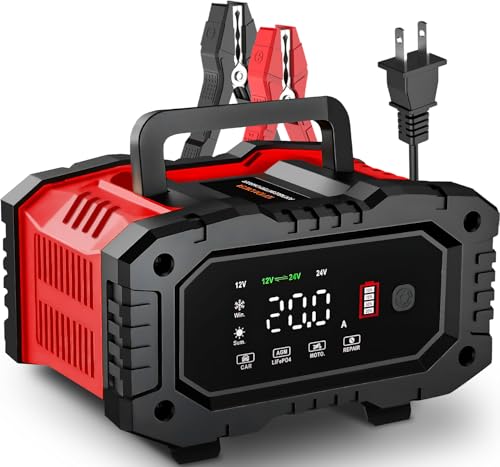
Huiaipaic 20-Amp Car Battery Charger

E-FAST Battery Charger 0-20A 12/24V
More Details On Our Top Picks
The ECO-WORTHY model leans into simple maintenance rather than brute-force charging, which suits a car that sits between errands or a marine battery that needs steady attention. Its LCD display helps you follow the process without squinting at tiny lights, and the mix of lead-acid and LiFePO4 support gives you useful flexibility for a small garage.
The trade-off is pace, since 5 amps is better for tending than rushing. For most weekend drivers, that’s exactly the point, and the desulfator function gives aging batteries a more careful routine than a plain plug-in maintainer.
Strong Points
- Handles both lead-acid and LiFePO4 batteries, which helps you cover a wider garage without stacking multiple chargers.
- The LCD screen makes charge status easier to follow during regular home use.
- 5-amp output keeps the focus on maintenance, so it fits batteries that spend long stretches in storage.
- Desulfator support adds value for batteries that have seen a few seasons of sitting around.
Things To Consider
- It’s not the right fit for someone who wants a fast recovery tool for large, deeply drained batteries.
- The compact maintainer style works best when you already understand the battery type you’re connecting.
- Storage is easy, but the smaller format also means fewer advanced controls than the higher-amperage picks here.
Feature Snapshot
Who It Suits Best
You’re a good match for this one if you want a compact maintainer for a car, boat, or backup battery that spends more time waiting than working.
A Better Fit Elsewhere
PZ.P 15-Amp 12V/24V Smart Battery Charger suits you better when you want faster charging with a wider stage-based routine.
After the compact ECO-WORTHY unit, this CRAFTSMAN charger feels more straightforward for general car care because it covers both 6V and 12V batteries. That makes it easier to keep in a garage with older equipment, a small mower, or a standard car battery that needs periodic attention.
The 12-amp output gives you more headroom than a basic maintainer, though it still sits in the everyday-use lane rather than the heavy recovery lane. You may find that balance useful if you want a familiar brand name without jumping to a bulkier, more complex charger.
What We Like
- 6V and 12V support helps you cover more household equipment with one charger.
- 12 amps gives you a useful step up from smaller maintainer-style models.
- The shape of the product fits regular garage storage without asking for much space.
- It suits common vehicles well, especially when you want uncomplicated battery upkeep.
Minor Gripes
- It does not chase the higher-output pace of the 15-amp and 20-amp picks later in the list.
- The dual-voltage focus is handy, but you still need to match the charger to the battery in front of you.
Details At A Glance
Built With In Mind
You’ll appreciate this pick most as a plainspoken garage charger for cars, lawn gear, and older 6V equipment.
Where A Sibling Pick Shines
Huiaipaic 20-Amp Car Battery Charger is the better match for truck owners or anyone wanting faster output on larger batteries.
The Haisito stands out because it stretches across 6V, 12V, and 24V systems, which gives you real flexibility in a mixed garage or a small work setup. The pulse repair feature, which is a charging method that sends quick pulses to help work through sulfation, adds a little more depth than the simpler maintainers above it.
That breadth is useful for car, boat, and RV owners, though the charger is still a maintainer and not a jump starter. The honest read is that it fits people who want one unit for several battery jobs, not a quick fix for a totally lifeless battery.
Highlights
- Three voltage options give you more versatility across vehicles and equipment.
- Automatic maintenance suits batteries that spend time in storage between uses.
- Pulse repair support can be useful for batteries that have started to lose efficiency.
- Its broad battery support helps reduce the need for separate chargers in a mixed setup.
- Good fit for boats and RVs, where a wider compatibility range matters.
Points To Note
- It is not a jump starter, so it won’t act like emergency start equipment.
- The wider feature set adds usefulness, but also more choice points during setup.
- Storage is still manageable, though the all-purpose design feels less minimal than the ECO-WORTHY charger.
Core Details
Whose Shelf It Belongs On
This fits you well if your garage holds more than one battery type and you want a single charger to cover the mix.
Another Choice May Suit
PZ.P 15-Amp 12V/24V Smart Battery Charger is a tighter fit for shoppers who want stage-based charging with temperature compensation instead of broader voltage coverage.
The PCHH unit pushes further into practical garage work with a 0 to 15-amp range and support for 12V and 24V batteries. Compared with the smaller ECO-WORTHY and CRAFTSMAN models, it gives you more room to work on trucks, motorcycles, lawn equipment, and boats without moving to a much larger charger.
Its auto shutoff and winter mode matter in real seasonal use, especially in colder months when batteries sit harder than usual. You may find the repair mode useful for routine upkeep, though the stronger output means it makes the most sense for people who want a more serious all-purpose charger.
Upsides
- Wide amperage range gives you flexibility for both lighter upkeep and stronger charging needs.
- 12V and 24V support suits more than one vehicle class.
- Auto shutoff helps keep charging routines less hands-on.
- Winter mode is a useful fit for cold-weather storage and seasonal equipment.
Small Caveats
- The broader control set means you’ll want to read the settings carefully before connecting it.
- It makes more sense in a busy garage than in a simple trunk kit.
- The heavier-duty profile can feel like more charger than a casual maintenance-only setup needs.
Feature Rundown
The Right Fit
This suits you best if your garage tools cover trucks, bikes, boats, and seasonal equipment that needs a more capable charger.
Skip It When
CRAFTSMAN 12A Car Battery Charger CMXCESM258 makes more sense for basic car upkeep and simpler dual-voltage needs.
The PZ.P model is the point in this list where charging logic starts to feel more deliberate, thanks to its 9-stage process and temperature compensation. Temperature compensation means the charger adjusts its behavior based on heat or cold, which matters in sheds, garages, and seasonal storage spaces where battery conditions change.
Compared with the PCHH pick, this one feels more tuned for careful charging than rough-and-ready flexibility. That makes it a strong match for motorcycle, car, truck, lawn mower, and boat batteries that spend time parked rather than being cycled hard every day.
Reasons To Buy
- 9-stage charging gives you a more structured battery care routine.
- Temperature compensation helps the charger react better to changing storage conditions.
- 12V and 24V support keeps it useful across several vehicle types.
- LiFePO4 and lead-acid compatibility broadens where it can live in your garage.
Areas To Watch
- The more advanced charging logic may feel like extra detail for casual one-vehicle owners.
- It’s not the smallest option here, so shelf space matters a little more.
At A Glance
Perfect Match For
You’ll get the most from this charger if you want a careful maintainer for a small collection of vehicles and storage batteries.
A Better Fit Elsewhere
Huiaipaic 20-Amp Car Battery Charger suits you better when speed matters more than a layered charging routine.
This Huiaipaic charger targets the person who wants more charging muscle without stepping into a shop-sized unit. Its 12V 20A and 24V 10A output pairing gives it a clear edge for larger batteries, and the 300-watt rating points to a more substantial power draw than the smaller maintainers in the list.
That extra capacity matters in real garages with truck batteries, boats, and larger lawn equipment. The trade-off is that you’re dealing with a more demanding charger, so it makes more sense for regular use than for an occasional trunk carry.
Best Bits
- Higher output helps cut down wait time on bigger batteries.
- Supports LiFePO4 plus lead-acid families like AGM, gel, and SLA.
- Works across cars, trucks, motorcycles, lawn equipment, and boats.
- 300-watt capability signals stronger charging headroom.
Worth Noting
- Its stronger output is more than many casual maintenance jobs need.
- The charger makes the most sense where you have enough space for regular storage and use.
Core Details
Who Should Grab It
You’re the right match for this charger if your garage sees bigger batteries and you want quicker recovery than a 5-amp maintainer can offer.
Look Elsewhere When
Haisito 16-Amp Smart Battery Charger is easier to live with for shoppers who want broader voltage coverage and a slightly lighter-feeling all-rounder.
The E-FAST charger rounds out the list as a flexible all-rounder with 0 to 20-amp output and support for both 12V and 24V systems. Compared with the Huiaipaic unit, it pushes into a similar stronger-output lane, while the trickle and pulse repair functions give it a maintenance angle that suits stored vehicles.
In a home garage with a car, motorcycle, and small utility gear, that mix can feel surprisingly practical. You may find it especially useful if you want one charger to stay on hand for several battery types without aiming for a specialized niche.
Positives
- 0 to 20 amps gives you broad control over charging pace.
- 12V and 24V compatibility makes it useful across multiple vehicle types.
- Trickle and pulse repair functions support routine battery upkeep.
- It fits the mixed-use garage better than a narrow single-purpose charger.
Softer Spots
- The wide feature set can feel like extra homework for simple maintenance jobs.
- It makes the most sense once you know the battery type and voltage you’re working with.
Technical Sheet
Who Will Love This
This is a solid fit for you if your garage rotates between cars, bikes, and seasonal equipment and you want one charger that can cover the spread.
Where Another Pick Suits Better
PCHH 12V 24V Car Battery Charger Heavy Duty is the better match for someone who wants winter mode and a more rugged feel.
How To Choose The Right 12v Automatic Battery Chargers
Match The Charger To The Battery Chemistry
Battery chemistry is the first thing worth checking because LiFePO4, lead-acid, AGM, and gel batteries do not always want the same charging behavior. A charger that clearly lists the types it supports saves you from guessing and helps you avoid buying a tool that only covers one corner of your garage.
That matters even more for mixed households, where a car, mower, boat, and backup battery may all live side by side. The safest approach is simple, read the supported battery list before you look at amperage or extras.
Think About Amperage As Charging Pace
Amperage tells you how much charging current the unit can provide, and higher numbers usually mean quicker recovery for larger batteries. A 5-amp maintainer works well for storage care, while 15-amp or 20-amp models fit bigger batteries and more frequent use.
The catch is that faster isn’t always better for every job. Smaller batteries and seasonal equipment often benefit more from steady upkeep than from a stronger charger that feels like overkill.
Decide How Much Control You Really Need
Simple auto-shutoff and automatic maintain mode suit casual use because they keep the process easy to follow. More advanced tools add stage-based charging, temperature compensation, and repair modes, which can help in colder spaces or with batteries that sit unused for long stretches.
That extra control is useful, but it also adds setup decisions. For a single car in a mild climate, a straightforward charger often makes more sense than a feature-heavy model.
Check The Use Case, Not Just The Label
A charger marked for cars can still be a weak fit for truck batteries, RV storage, or boat use. Shape, storage space, display style, and whether you want a maintainer or a more aggressive charger all matter in real garages.
The right match should fit the way you actually keep equipment, not the way a product page sounds on paper. That’s the difference between a tool you reach for often and one that spends most of its life in a drawer.
What To Weigh Before You Choose
Hidden Buying Traps
One common mistake is overlooking voltage support and ending up with a charger that only fits part of your gear. Another is treating a maintainer like a jump starter, which creates the wrong expectation for emergency use.
Storage size matters too. A bulky unit can be a nuisance in a tight shelf or trunk, especially when a smaller maintainer would cover the same routine job.
The Upgrade Payoff
Higher-tier chargers often cost more because they offer broader voltage support, faster output, and more refined charging logic. Features such as temperature compensation, repair modes, and multi-stage charging usually show up in these models because they take more engineering to build.
The upgrade makes sense for mixed fleets, colder garages, and equipment that sits unused for long periods. For a single commuter car, the extra capability can be more than you need, but for a garage that handles several battery types, it earns its place quickly.
Frequently Asked Questions
What does an automatic battery charger actually do?
It charges a battery and then adjusts or stops output as the battery approaches full. That makes routine upkeep much simpler than watching the process by hand.
Can one charger work on both 12V and 24V batteries?
Yes, but only when the product listing clearly says it supports both. Matching the voltage keeps the charger aligned with the battery’s needs.
Do LiFePO4 batteries need a special charger?
They often perform best with chargers that explicitly mention LiFePO4 support. A generic lead-acid unit may not be the right match.
Is a higher-amp charger always better?
No, because small batteries and maintenance jobs often benefit from slower, steadier charging. Higher amperage helps most when you work with larger batteries or want faster turnaround.
What’s the difference between a maintainer and a repair mode?
A maintainer keeps a battery topped up over time, while repair-style modes aim to help with neglected batteries. The repair feature can be useful, but it is not a substitute for a battery that has failed outright.
Closing Thoughts
The best 12v Automatic Battery Chargers for you come down to battery type, charging pace, and how often your gear sits unused. ECO-WORTHY and CRAFTSMAN cover the simpler end, while Haisito, PCHH, PZ.P, Huiaipaic, and E-FAST move into broader, more capable territory. Pick the smallest charger that still matches your real setup, and you’ll end up with something useful instead of something flashy. That’s usually the smartest place to land.