


Two-bank charging setups make sense for boats with twin batteries, trolling motors, or a starting bank paired with a house bank. The right charger keeps maintenance simple, especially after long weekends on the water or a season of storage. You also want the right mix of waterproofing, battery chemistry support, and bank output so the charger fits your hull, not the other way around.
The seven picks below cover straightforward onboard charging, smarter lithium-capable options, and rugged units for damp marine spaces. You’ll see clear differences in bank output, waterproof ratings, and battery compatibility, so you can match the charger to your boat and your routine.
Quick Shortlist For Busy Dock Days

Guest 2707A Guest On-Board Battery Charger 8A / 12V, 2 Bank

ProMariner 44012 ProSport HD Waterproof Marine Battery Charger, 12 Amp, 2 Bank

2 Bank Marine Battery Charger 5X2, 10A (5A/Bank) – 12V Boat Charger

2 Bank Marine Battery Charger, 10A (5A/Bank) 12V Waterproof On BOAD Boat Battery Charger

smart 2 Bank Marine Battery Charger, 10A (5A/Bank), 12V, Waterproof, Lifepo4 Lithium Battery Charger

LiTime 2 Bank 12V 10A LiFePO4 Battery Charger, Waterproof, 14.6V Output
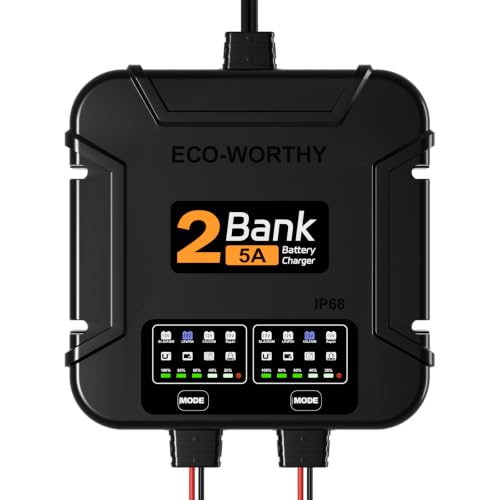
ECO-Worthy 2 Bank Marine Battery Charger 5X2, 12V 10A (5A/Bank)
Guest keeps this one focused on the basics, which helps in a boat that just needs steady two-bank charging without extra fuss. The 8 amp output and 120V input point to a straightforward onboard setup for common dockside power.
You may like that kind of restraint more than flash, especially for a weekend runabout or a small fishing boat with two 12V batteries. The trade-off is simple, it looks less feature-heavy than newer lithium-leaning chargers, so it fits the classic maintenance role better than a high-tech upgrade path.
What We Like
- Two-bank charging keeps each battery on its own path.
- 8 amp output suits modest charging needs.
- 120V input fits standard shore-powered use.
- Clean onboard format is easy to live with.
Things To Consider
- Output is modest beside stronger 10A and 12A picks.
- Feature set looks more basic than the smarter models here.
- Best fit leans toward simple routine charging, not advanced battery care.
Feature Snapshot
Who It Suits Best
Dockside boat owners with a simple 12V two-battery setup will get the most from this charger.
A Better Fit Elsewhere
ProMariner 44012 ProSport HD Waterproof Marine Battery Charger, 12 Amp, 2 Bank suits you better when faster charging and a more feature-forward build matter more.
ProMariner brings more charging headroom than the Guest unit above, and that extra 12 amp output matters on boats that see longer gaps between outings. The waterproof design also makes sense in a wet bilge or a cockpit storage area where splashes are part of normal life.
For a cruiser or a boat with two batteries that you want ready sooner, this sits in a more confident lane than the basic Guest 2707A. The honest trade-off is that a more capable unit can feel like more charger than a tiny skiff really needs.
Highlights
- 12 amp output gives you more charging pace.
- Waterproof housing suits exposed marine spaces.
- Two-bank layout still keeps the setup orderly.
- Good fit for boats that sit unused between trips.
Worth Noting
- Higher output may be more than a small boat needs.
- Waterproof construction helps, but mounting still needs care.
- Less plain and simple than the Guest option.
Core Details
Who Should Grab It
Boat owners who want quicker two-bank charging and a waterproof shell will find the fit strongest here.
Swap It Out When
Guest 2707A Guest On-Board Battery Charger 8A / 12V, 2 Bank makes more sense for smaller boats that only need a simpler, lower-output charger.
FirstPower Pro splits its 10 amp output into 5 amps per bank, which gives the setup a neat, even feel for two-battery boats. That matters in everyday use because both batteries get attention without one bank hogging the work.
The waterproof build and the broader support for lead-acid and lithium battery types make this more flexible than the first two picks. You may find that flexibility useful on a mixed-chemistry boat, though the long product name hints at the kind of listing clutter that can make comparison shopping feel a little messy.
Upsides
- 5 amps per bank creates a balanced split.
- Supports both lead-acid and lithium battery use.
- Waterproof design suits onboard mounting.
- Good middle ground for mixed battery needs.
Areas To Watch
- Bank output is steady, not especially aggressive.
- Listing clutter can make the model harder to sort at a glance.
- Best fit depends on whether your batteries are mixed or uniform.
Details At A Glance
Built With In Mind
Two-battery boat owners who need balanced output and chemistry flexibility will get the strongest fit here.
Another Choice May Suit
LiTime 2 Bank 12V 10A LiFePO4 Battery Charger, Waterproof, 14.6V Output makes more sense for lithium-first setups that need a more focused charger.
SOARFLY leans into battery care rather than raw pace, which is useful for boats that spend time in storage or on a trailer. The maintainer and desulfator functions point to longer-term upkeep, so your batteries get a gentler, more attentive routine.
Compared with the FirstPower Pro, this one feels more maintenance-minded than chemistry-flexible. The trade-off is that the wording around the product title is awkward, so the listing takes a little extra reading before the useful parts click into place.
Reasons To Buy
- Maintainer function suits storage periods and off-season care.
- Desulfator role adds a battery-care angle.
- 5 amps per bank keeps charging controlled.
- Waterproof construction fits typical marine exposure.
Small Caveats
- Not as quick as higher-output options here.
- Product wording feels clumsy, which can slow down comparison shopping.
- Best value depends on how much you care about long-term upkeep.
Quick Facts
Perfect Match For
Boat owners who store their batteries for stretches and want a care-focused charger will appreciate this one most.
Reach For A Different Pick When
ProMariner 44012 ProSport HD Waterproof Marine Battery Charger, 12 Amp, 2 Bank suits you better when faster turnaround matters more than maintenance features.
Zrfmib looks aimed at owners who want a smarter maintenance layer without jumping all the way to a lithium-specialized unit. The 10 amp total output and 5 amps per bank keep it in the same practical range as the SOARFLY model, but the smart charger angle gives it a more modern feel.
That makes sense for AGM, lithium, and deep-cycle setups on boats where a little charging intelligence matters. You may notice the listing reads a bit compressed, though the actual use case is clear enough: steady two-bank care with waterproof peace of mind.
Best Bits
- Smart charger design adds a more attentive charging style.
- Works with AGM, lithium, and deep-cycle batteries.
- 5 amps per bank keeps charging even.
- Waterproof build fits marine storage and dock use.
Points To Note
- 10A total is useful, but not especially brisk.
- Listing style is dense, so the key details take a careful read.
- Most useful when your boat uses mixed battery types.
Feature Rundown
Whose Shelf It Belongs On
Owners of mixed battery setups who want a smarter two-bank charger will get the most from this choice.
Where A Sibling Pick Shines
LiTime 2 Bank 12V 10A LiFePO4 Battery Charger, Waterproof, 14.6V Output is the sharper fit for lithium-first systems that need a more dedicated output profile.
LiTime stands out by putting LiFePO4, a lithium iron phosphate battery type, front and center, and that narrows the fit in a useful way. The 14.6V output, IP65 protection, LED indicator, and 0V activation all point to a charger built for lithium-first boats and mixed setups that need a more specialized approach.
That makes it more targeted than the broader Zrfmib or FirstPower Pro picks, especially for kayaks, trolling motors, and marine rigs that lean on lithium batteries. The trade-off is simple, a focused charger can be less appealing for someone who only wants basic lead-acid charging.
Strong Points
- 14.6V output fits LiFePO4 charging needs.
- 0V activation helps with deeply drained batteries.
- LED indicator adds a clear status cue.
- IP65 rating supports wet, dusty, and exposed marine spaces.
- Works with both lithium and lead-acid batteries.
Honest Caveats
- Most compelling for lithium-first setups, not plain basic use.
- More specialized than the broader two-bank choices.
- 14.6V output may feel too specific for some mixed fleets.
Technical Sheet
Right Fit For
Lithium-focused boat owners and trolling motor setups will get the clearest benefit from this charger.
Look Elsewhere When
Guest 2707A Guest On-Board Battery Charger 8A / 12V, 2 Bank works better for someone who wants a simpler, less specialized charging routine.
ECO-Worthy pushes hardest on ruggedness, and the IP68 rating signals a more sealed build than the waterproof chargers above. That matters on boats, RVs, and even garage setups where moisture and dust can be part of the routine.
Its 5A per bank layout stays familiar, but the activate and repair wording suggests a charger aimed at batteries that need a little more attention. You may prefer it for tougher environments, though the broader use list means it feels less narrowly marine than the LiTime pick.
Plus Points
- IP68 protection gives it a more sealed feel.
- 5A per bank keeps the charge split even.
- Activate and repair functions suit battery upkeep.
- Works across lead-acid and lithium use cases.
- Useful beyond boats, including RV and car storage setups.
Areas To Watch
- Broader use range can make the marine focus feel less tight.
- 5 amps per bank is steady, not fast.
- Best value shows up in harsher conditions or storage-heavy use.
Core Details
The Right Fit
Owners who need a tougher charger for damp, dusty, or storage-heavy environments will appreciate this one most.
Where A Sibling Pick Shines
ProMariner 44012 ProSport HD Waterproof Marine Battery Charger, 12 Amp, 2 Bank is the cleaner pick for someone who wants a more marine-first charger with stronger output.
How To Choose The Right 2 Bank Marine Battery Chargers
Match The Charger To Your Battery Mix
Start with battery chemistry, because that decides how useful the charger will feel once it’s mounted. Lead-acid, AGM, deep-cycle, and LiFePO4 batteries all behave differently, so a charger like LiTime makes more sense for lithium-first boats, while Guest is better for a plain 12V setup.
Bank output matters too, since 5 amps per bank and 8 amps total do not serve the same pace of use. A weekend boat that sits between outings can live with slower charging, but a boat that gets used hard or stored for long stretches benefits from more headroom.
Think About Mounting, Water, And Access
Marine chargers live in less friendly places than a bench-top charger, so waterproofing deserves real attention. Waterproof, IP65, and IP68 are all different levels of sealing, and the higher numbers generally point to more protection against moisture and dust in exposed locations.
That becomes important in a bilge, under a console, or anywhere spray and humidity show up often. A more sealed unit usually costs more, but it also suits the reality of boat storage better than a barebones indoor charger.
Choose Output For Your Routine, Not Just The Label
Higher amp ratings help shorten the wait between trips, but they are not a universal answer. A 12 amp model like ProMariner fits larger or more active boats, while a 10 amp charger often lands in the practical middle for two-bank use.
For smaller boats, the extra output can be more charger than you need, and that just adds cost without much payoff. For owners who launch often, a quicker recovery window can be worth the step up.
Look At Care Features With Realistic Expectations
Some chargers do more than push power, with maintainer, desulfator, 0V activation, or repair functions aimed at battery upkeep. Those features are useful for stored boats and seasonal use, but they do not turn tired batteries into new ones.
Think of them as support tools rather than magic. They help keep batteries healthier and easier to manage, especially when your boat spends long stretches parked.
What To Weigh Before You Choose
Common Shopping Slip Ups
Many people focus on total amps and ignore bank split, which is how a charger can look strong on paper but feel slower in use. A 10A total charger that divides power evenly may suit two batteries better than a higher single-bank figure with less balance.
Another easy miss is battery chemistry. A charger built around lithium use will not be the calmest fit for a simple lead-acid setup, and a basic charger can feel underdone on a LiFePO4 boat.
Where The Extra Money Goes
More expensive models usually pay for better sealing, smarter charging logic, and broader battery support. That shows up in units like LiTime and ECO-Worthy, where the design leans toward more controlled charging and tougher environmental fit.
The upgrade makes sense for boats that live outdoors, see salt spray, or rely on lithium batteries. For a small inland boat with light use, a simpler charger often covers the need without extra complexity.
Frequently Asked Questions
What does a 2 bank marine battery charger do?
It charges two batteries through separate outputs, so each bank gets its own charging path. That setup works well for boats with a start battery and a second battery for accessories or trolling.
Do you need waterproofing in a marine charger?
Waterproofing helps a lot in real boat use because chargers often live near spray, humidity, or damp storage areas. The exact level of protection matters, especially if the mounting spot is exposed.
Can one charger handle lithium and lead-acid batteries?
Some can, but the listing needs to say so clearly because those battery types charge differently. A model that names both battery families usually gives you more flexibility.
Is higher amperage always better?
Not always, because the right output depends on battery size, use frequency, and how quickly you want the batteries ready again. A modest charger can be the better match for small boats and light schedules.
What makes a maintainer or desulfator useful?
Those functions are aimed at long-term battery upkeep and stored batteries. They fit seasonal boats especially well, where batteries spend time parked between outings.
Closing Thoughts
The best 2 bank marine battery chargers for 2026 depend on how your boat lives, not just on output numbers. Guest keeps things simple, ProMariner brings more pace, LiTime leans hard into lithium use, and ECO-Worthy feels built for rougher conditions. Match the charger to your batteries, your storage space, and how often you head out, and the choice gets much easier. A good fit here feels quiet in the background, which is exactly what you want on the water.