
Getting sound right on a boat is less about flash and more about survival against spray, glare, and cramped dash space. You want a stereo that fits the helm cleanly, handles routine use without drama, and gives you the inputs you actually use on the water or on the road.
This roundup keeps the focus on practical budget picks, from simple digital media receivers to fuller setups with speakers. You’ll see where a single DIN unit makes sense, where a weather-resistant face earns its keep, and which models suit a quiet cockpit versus a busier family boat.
Quick Look At Our Shortlist

Sony DSXM55BT Bluetooth Marine Digital Media Stereo Receiver
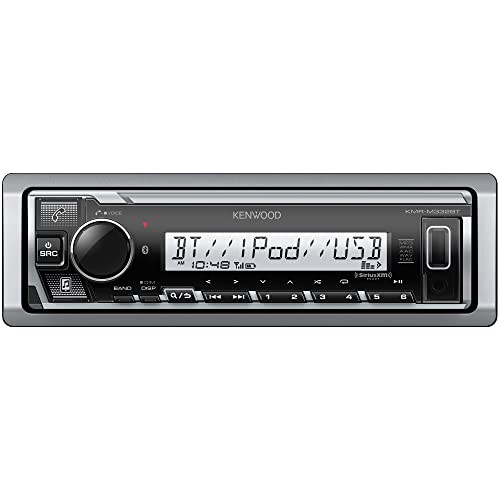
KENWOOD KMR-M332BT Car & Marine Stereo Single Din

Kicker 46KMC2 Weather-Resistant Gauge-Style Media Center

Pyle Marine Radio Single DIN Receiver

BOSS Audio Systems MCK632WB.6 Marine Bluetooth Stereo and 6.5 Inch Speakers

KENWOOD KMR-D382BT Single Din Car/Marine Stereo Head Unit

JVC KD-X560BT Digital Media Car & Marine Bluetooth Receiver
More Details On Our Top Picks
For a compact helm or a clean dash retrofit, this Sony keeps the setup simple and focused on media playback. The single-DIN format helps it slide into tighter spaces, which matters on smaller boats or older consoles with limited cutout room.
The SiriusXM-ready note also gives you room to expand your listening mix later, and that’s useful on long runs where streaming alone can feel repetitive. The trade-off is that it’s a media receiver, so you’re choosing a leaner layout over a more crowded control panel.
Strong Points
- Single-DIN sizing suits compact dashboards and older marine cutouts.
- Bluetooth keeps phone pairing straightforward for dockside playlists or road use.
- SiriusXM readiness leaves room for satellite listening later.
- The straightforward layout fits first-time upgrades without much fuss.
Things To Consider
- You’re working with a media-focused unit, so it won’t suit anyone wanting a disc player.
- The simpler face design means fewer built-in controls than fuller-featured head units.
- Like most dash gear in a marine setting, keeping the face and surrounding trim clean helps it stay easy to read.
Feature Snapshot
Who It Suits Best
You’re the right fit for this Sony if you want a tidy, no-nonsense marine receiver for a smaller boat, weekend cruiser, or daily driver with a shared audio setup.
A Better Fit Elsewhere
KENWOOD KMR-D382BT suits you better if you want a single-DIN unit with a CD player and a more traditional source mix.
This Kenwood leans more like an all-round daily unit, with Bluetooth, USB, AUX, and standard radio sources packed into one single-DIN face. For a boat that doubles as a weekend car audio project, that mix keeps you from feeling boxed in.
Weatherproof construction is the big practical note here, because marine use rarely stays perfectly dry or calm. The multi-color illumination also helps at night, though the honest trade-off is that more features usually mean a busier face to learn.
Highlights
- Bluetooth, USB, AUX, and AM/FM cover most everyday listening habits.
- Single-DIN sizing works in many standard marine and car dashboards.
- Weatherproof design suits damp cockpits and open-air installs.
- Multi-color illumination can match different dash lighting setups.
Worth Noting
- Feature depth can make the front panel feel busy at first glance.
- The look is more functional than polished, so style-first setups may want something cleaner.
- Keeping the buttons and display area free of salt buildup helps preserve readability.
Details At A Glance
Who Will Love This
You’re in the sweet spot for this Kenwood if you want a flexible marine stereo that feels comfortable in both a boat and a vehicle.
Look Elsewhere When
JVC KD-X560BT suits you better if rear camera input matters more than broad source support.
The round, gauge-style format makes this Kicker feel purpose-built for open helms and tighter dash layouts where a rectangular radio looks awkward. It also suits you well if you want a clean, center-console look instead of a bulky stack of controls.
The readable screen and rotary encoder, meaning the main control wheel, keep operation more tactile than touch-heavy. That tactile feel is handy on a moving boat, though the compact format naturally gives you less room for extra functions than a larger head unit.
Reasons To Buy
- Gauge-style mounting suits open-helm and console layouts.
- Rotary control feels easier to manage with wet hands than tiny buttons.
- The screen is easy to read at a glance.
- Bluetooth streaming covers casual phone-based listening.
- Peak output across four channels gives it a stronger headline power figure than the slimmer media-only picks above.
Softer Spots
- The round design narrows placement options compared with a standard single-DIN face.
- Compact receivers like this usually ask you to trade some versatility for a tidier dash fit.
- Keeping the bezel and display clear of grime matters more on open boats than in enclosed cabins.
Feature Card
Made For
You’re a strong match for this Kicker if your boat has an open helm, a round dash opening, or a layout that rewards compact, centered controls.
Swap It Out When
Pyle Marine Radio Single DIN Receiver fits better for anyone who wants a more conventional rectangular stereo face with broader source support.
This Pyle lands in the useful middle ground, with Bluetooth streaming, AM/FM radio, USB, AUX, and hands-free calling in one single-DIN package. That makes it a sensible fit for a budget-conscious helm upgrade where you still want several playback paths.
The remote control and RGB button lighting help on a dim dash, though the look stays more utility-first than polished. The honest read is that it makes the most sense in a boat where function matters more than a high-end finish.
Best Bits
- Bluetooth and wired inputs cover different listening habits.
- Hands-free calling can be useful in a vehicle or dockside setup.
- Remote control adds convenience from the passenger seat or helm.
- RGB buttons help the face stand out in darker conditions.
Minor Gripes
- The feature mix is broad, but the styling is plain.
- More functions mean more labels to learn during setup.
- For marine use, a regular wipe-down helps keep button markings easy to see.
Core Details
The Right Fit
You’ll like this Pyle most as a straightforward upgrade for a small boat, fishing rig, or everyday vehicle where broad source support matters more than premium finishing.
Another Choice May Suit
KENWOOD KMR-M332BT is a better fit for you if weatherproof design and a more established brand feel matter more than the Pyle’s extra convenience features.
This BOSS package stands apart because it gives you the stereo and the 6.5-inch speakers together, which helps new installs feel less pieced together. For a small boat build or a first-time audio refresh, that bundling can save you from matching separate parts one by one.
The detachable front panel adds a practical layer of security when the boat is parked, and the included dipole antenna means the setup is more complete out of the box. The trade-off is that combined kits usually take a little more planning during installation than a lone receiver.
Positives
- Receiver and speakers in one kit simplify the shopping step.
- 6.5-inch speakers suit compact marine audio zones well.
- Detachable face can be useful for storage after use.
- USB and AUX inputs keep playback flexible.
- 50W x 4 output is a useful reference for power planning.
Points To Note
- A bundle needs more installation coordination than a standalone head unit.
- The included components make it less minimal than the Sony DSXM55BT or JVC KD-X560BT.
- Speaker grilles and front-panel surfaces benefit from regular cleaning in salty air.
Quick Facts
Whose Shelf It Belongs On
You’re the best match for this BOSS kit if you want a more complete starter system for a boat that needs both a receiver and speakers at once.
Reach For A Different Pick When
KENWOOD KMR-D382BT suits you better if you want a single head unit with CD support instead of a bundled speaker set.
This Kenwood is the most old-school friendly unit in the group, because it keeps a CD player alongside Bluetooth, USB, and AM/FM radio. That mix suits you well in a boat or garage setup where your music still lives on discs and flash drives, not just your phone.
Hands-free calling and SiriusXM readiness widen the use case, and the 50W x 4 channel rating gives you a clearer sense of its amplifier setup on paper. The drawback is simple, more source options mean more to manage, so it fits someone who values flexibility over a minimal face.
Upsides
- CD playback gives you a source type missing from many newer media receivers.
- Bluetooth and USB cover phone and file-based listening.
- Hands-free calling adds day-to-day convenience beyond music.
- AM/FM and SiriusXM readiness widen listening choices.
- 50W x 4 channel output gives it a clear power spec.
Areas To Watch
- The source menu is broader than basic users may need.
- Disc access adds another moving part to maintain over time.
- In a wet boat environment, keeping the face clean matters more because there are more controls and loading points.
Technical Sheet
Built With In Mind
You’ll get the most from this Kenwood if you want a dependable marine-capable unit that still respects older music formats.
A Better Fit Elsewhere
Sony DSXM55BT suits you better if you want a simpler media-first face with less emphasis on disc playback.
The JVC makes a strong case for everyday use because it covers phone playback, USB, AUX, and rear camera input in a compact digital-media layout. That rear camera support matters most on trailers, tight docks, and any vehicle-boat setup where backing visibility helps.
Its iPhone and Android compatibility keeps the phone side broad, and the simpler digital-media approach means fewer old-school extras to manage. Compared with the Kenwood KMR-D382BT, it gives you a cleaner path for modern device use, though you give up the CD slot.
Bright Spots
- Rear camera input is a practical bonus for maneuvering.
- Phone, USB, and AUX support cover common media habits.
- Digital-media design keeps the face uncluttered.
- iPhone and Android support makes pairing less restrictive.
Small Caveats
- You won’t get CD playback here, so disc libraries need another solution.
- The cleaner layout trades some legacy flexibility for simplicity.
- On a boat, keeping the rear-input and face area clean helps preserve easy connection access.
Core Details
Whose Shelf It Belongs On
You’re the right match for this JVC if you want a clean, modern receiver for a boat, tow vehicle, or dockside setup where rear camera input genuinely helps.
Another Choice May Suit
KENWOOD KMR-M332BT suits you better if weatherproof design and SiriusXM readiness matter more than the JVC’s camera-focused layout.
How To Choose The Right Budget Marine Stereos
Start With The Dash, Not The Brochure
Marine stereos rise or fall on fit. A single-DIN unit suits many standard cutouts, while a gauge-style receiver like the Kicker 46KMC2 works better in a round helm opening or a compact center console.
That matters because cramped installations get messy fast, and the wrong face shape can turn a straightforward upgrade into a trimming project. The cleanest choice is usually the one that matches the opening you already have.
Match The Source Mix To How You Listen
Some setups live on Bluetooth alone, while others still lean on USB sticks, AUX cables, AM/FM radio, or even CDs. A digital-media model like the JVC KD-X560BT feels neat and modern, but the KENWOOD KMR-D382BT makes more sense for anyone with a disc library.
Think about real habits on the boat. Long cruises, dockside hanging out, and short runs all reward different source options, so the right stereo is the one that fits those habits without making the face harder to use.
Pay Attention To Wet-Use Details
Weather-resistant or splash-resistant construction matters more than marketing language suggests. In an open boat, a sealed front, a simpler button layout, and easy-to-wipe surfaces can make day-to-day ownership much less annoying.
That’s also why bundled kits and receiver-only models serve different people. A full setup like the BOSS package helps when you want one purchase to cover more of the system, while a lean unit such as the Sony DSXM55BT keeps installation simpler.
Think About Power, Controls, And Night Use
Power ratings matter, but only in context. The 50W x 4 figure on the KENWOOD KMR-D382BT and the over-200-watt peak claim on the Kicker 46KMC2 help you compare headline output, yet the real payoff depends on speaker match, cabin size, and how loud you actually listen.
Controls matter just as much. Rotary knobs, readable screens, and button illumination help when glare is harsh or the boat is moving, and that usually feels more valuable than a long feature list that you rarely touch.
What To Weigh Before You Commit
Mistakes Worth Dodging
One common miss is choosing a feature-heavy unit that doesn’t match the dash opening. Another is buying for a future setup you may never finish, such as extra inputs or bundled speakers that complicate the install.
It also helps to think about maintenance from the start. Salt, sunscreen, and spray can build up around buttons and trim, so a simple face is often easier to live with than an overly busy one.
Where The Extra Money Goes
Higher-tier models usually spend more on weather handling, more polished controls, cleaner display behavior, or bundled accessories. You’re not just paying for sound, you’re paying for a more complete ownership experience around the helm.
That upgrade is worth it when the boat sees regular use, the dash sits in open air, or you want a system that feels calmer to operate at night. For occasional use on a small runabout, a simpler unit can be enough.
Frequently Asked Questions
Do Budget Marine Stereos Need A Special Install?
Many of them use standard single-DIN sizing, so they fit common openings without drama. The exact install still depends on the dash layout and wiring behind it.
Is Bluetooth Enough For Boat Audio?
Bluetooth works well for most casual listening and phone-based playlists. USB, AUX, radio, or CD support still helps when you want backup source options.
What Makes A Marine Stereo Different From A Car Stereo?
Marine models are built with wet, bright, and open-air use in mind. That usually means better protection against spray and controls that stay easier to manage outdoors.
Are Speaker Bundles Worth It?
Speaker bundles can simplify a first-time setup because the pieces are matched from the start. A standalone head unit makes more sense when you already have speakers you trust.
Should You Choose A Digital Media Receiver Or A CD Player?
A digital-media receiver fits modern phone-heavy listening and usually keeps the face cleaner. A CD player still matters if your music library lives on discs or you want more source flexibility.