

Dead batteries rarely show up at a good time, and the right charger turns a stalled morning into a routine fix. These seven automatic battery chargers cover everything from simple garage maintenance to heavier-duty charging for trucks, motorcycles, lawn mowers, and boats. You’ll also find options with 6V and 12V support, plus models built for 12V/24V systems, so you can match the charger to the vehicles you actually keep around.
The real question is less about raw amperage and more about fit, safety features, and how much hands-on work you want. A compact maintainer suits a weekend car, while a higher-output smart charger makes more sense for mixed fleets or older batteries that need a steadier recovery path.
The Shortlist At A Glance

Schumacher Electric Wheeled 6A Car Battery Charger & Maintainer SC1364

Schumacher Electric Wheeled 6A Car Battery Charger & Maintainer SC1353

PCHH 12V 24V Car Battery Charger Heavy Duty 0-15A Automatic Battery Maintainer

Clore Automotive PL2310 10-Amp Fully-Automatic Smart Charger 6V and 12V

PZ.P 15-Amp 12V/24V Smart Battery Charger Maintainer & Trickle Charger

E-FAST Battery Charger 0-20A 12/24V Lifepo4 Lead Acid Automatic Smart Car Battery Charger
Schumacher Electric 6A Car Battery Charger & Maintainer FR01335
More Details On Our Top Picks
The wheeled base makes this Schumacher feel more like garage gear than a small benchtop charger, which matters if you move it between vehicles or store it with other tools. Its 12V engine-start function and 20-amp boost charge point to a more urgent use case, so it suits a dead daily driver, a work truck, or a weekend vehicle that sits too long.
You may find the larger footprint less handy in a tight apartment storage shelf, but that same size helps in a busy home garage where cables and cases tend to pile up. Compared with the more basic Schumacher FR01335 later in this list, this one leans harder into recovery work instead of simple upkeep.
Strong Points
- Wheeled design makes repositioning easier in a garage.
- 12V engine start adds a practical recovery option.
- 20-amp boost charging helps shorten long waits on larger batteries.
- Works well for households that keep more than one vehicle.
Points To Note
- The larger chassis takes more room than a compact maintainer.
- That higher-output setup is more than many casual drivers need.
- Cable storage can matter more with wheeled units, so neat placement helps.
Feature Snapshot
Who It Suits Best
Home mechanics, garage owners, and anyone who wants a charger that can do more than keep a battery topped off will get the most from this one.
Where A Sibling Pick Shines
Schumacher Electric 6A Car Battery Charger & Maintainer FR01335 fits better for routine upkeep on a single car, especially when you want a simpler, lighter setup.
SC1353 stays in the same wheeled Schumacher family as the SC1364, but the emphasis here feels more about straightforward maintenance than emergency-style recovery. That makes it a comfortable fit for a garage where a car, mower, or spare battery sits for stretches and needs steady attention.
In a cluttered storage area, the rolling base helps you move it without dragging a heavy block across the floor. The honest read is that it suits plain, dependable charging work better than dramatic rescue jobs, so the SC1364 still makes more sense for drivers who want stronger starting support.
What We Like
- Wheeled format is easier to shift around than a fixed desktop charger.
- 6-amp charging suits regular upkeep and less frantic battery care.
- Schumacher’s familiar layout helps keep the learning curve mild.
Worth Noting
- It is built more for maintenance than heavy recovery work.
- The rolling body still needs floor space for storage.
- Shoppers wanting more battery chemistry flexibility may prefer a broader-spec pick later in this list.
At A Glance
Made For
It suits someone who wants a steady, easy-to-roll charger for keeping a single vehicle or seasonal machine ready.
Another Choice May Suit
Schumacher Electric Wheeled 6A Car Battery Charger & Maintainer SC1364 is the better route for drivers who want engine-start support and a stronger boost charge.
PCHH broadens the field because it covers both 12V and 24V systems and reaches up to 15 amps, so it speaks to households with mixed vehicles rather than one simple sedan. The auto shutoff, repair mode, winter mode, and support for AGM batteries make it feel more like a multi-use shop tool than a plain trickle charger.
That extra flexibility comes with a little more menu reading than the simpler Schumacher units, so it suits you best when you have several vehicles or a seasonal machine that sits through colder months. For mixed garages, though, the range is useful and the trade-off feels fair.
Highlights
- 12V and 24V support gives it broader garage coverage.
- 15-amp output helps it cover both upkeep and faster charging.
- Auto shutoff reduces the need to babysit the process.
- Repair and winter modes add flexibility for seasonal storage.
- AGM compatibility helps it fit more modern battery types.
Things To Consider
- The feature set takes a little more attention than a basic maintainer.
- Users who only own one small car may not need this much range.
- Like many multi-mode chargers, setup and cable organization matter in a cramped garage.
Details At A Glance
Right Fit For
This suits you best if your garage includes cars, trucks, motorcycles, lawn equipment, or other gear that does not all use the same battery setup.
Look Elsewhere When
Schumacher Electric 6A Car Battery Charger & Maintainer FR01335 is a calmer fit for a single everyday car and a simpler charging routine.
The PL2310 stands out for people who want a more measured smart charger rather than a heavy recovery unit. Its 10-amp output, 6V and 12V support, and temperature compensation make it feel well suited to garages where batteries face big seasonal swings.
Temperature compensation means the charger adjusts how it behaves based on battery temperature, which matters more than it sounds for stored vehicles in hot sheds or chilly workshops. Compared with the PCHH, this Clore option is less about broad voltage coverage and more about steady, controlled charging for classic cars, lawn equipment, and everyday vehicles.
Upsides
- 6V and 12V support opens the door to more battery types.
- Temperature compensation helps it adapt to changing storage conditions.
- 10-amp output is a comfortable middle ground for many garages.
- Fully automatic operation keeps day-to-day use straightforward.
Softer Spots
- It does not aim for the faster recovery pace of higher-output models.
- Shoppers with 24V equipment will need a different pick.
- The more tuned charging approach may feel more detailed than a plain maintainer.
Core Details
Whose Shelf It Belongs On
It belongs with hobby mechanics, classic-car owners, and anyone who keeps a mix of 6V and 12V batteries in regular rotation.
Swap It Out When
PCHH 12V 24V Car Battery Charger Heavy Duty 0-15A Automatic Battery Maintainer is the better fit for mixed-voltage garages that also need 24V support.
PZ.P brings a more modern feature mix than the simpler maintainers above it, especially for households that use both LiFePO4 and lead acid batteries. The fully automatic 9-stage process, plus temperature compensation, makes it a thoughtful pick for motorcycles, cars, trucks, lawn tools, and boats that spend time off the road.
That broader chemistry support is the key reason it sits higher on this list, though you may find the extra capability more than you need for one commuter car. For mixed equipment and battery types, it feels like the kind of charger that saves you from buying several separate units.
Best Bits
- Works with both LiFePO4 and lead acid batteries.
- 15-amp output suits faster charging as well as maintenance.
- 9-stage automatic charging gives it a more careful process.
- Temperature compensation adds seasonal flexibility.
- Handles a wide spread of garage and recreational equipment.
Areas To Watch
- The extra feature set makes it more involved than a plain maintainer.
- Single-vehicle owners may not use all of its range.
- Multi-stage charging can feel like more charger than a simple plug-in fix.
Feature Card
Built With In Mind
It suits mixed garages, recreational owners, and anyone who wants one charger for several battery chemistries.
Where A Sibling Pick Shines
Clore Automotive PL2310 10-Amp Fully-Automatic Smart Charger 6V and 12V is the gentler fit for a simpler, mostly 6V and 12V garage.
The E-FAST charger pushes harder than the 15-amp PZ.P, and that extra headroom matters in busier garages where you want a stronger top end. Its 0 to 20-amp range, 12V and 24V support, and pulse repair mode make it appealing for more demanding battery upkeep across cars, trucks, motorcycles, lawn mowers, and boats.
Pulse repair is meant for a more restorative charging pattern, although the real value here is the wider current range and the way it covers so many common vehicle types. The trade-off is that a tool with this much range rarely feels as minimal as a basic maintainer, so it suits you best when your charging chores are varied.
Bright Spots
- 0 to 20 amps gives it a broad charging range.
- 12V and 24V support adds practical flexibility.
- Pulse repair mode gives it a more advanced maintenance profile.
- Works across many common garage and yard machines.
Minor Gripes
- The extra capability can feel more complex than a simple plug-in maintainer.
- Shoppers with one everyday car may not need the full output spread.
- In a small storage area, a bigger-feature charger can be a little more fussy to tuck away.
Quick Facts
Who Should Grab It
It fits tinkerers, multi-vehicle homes, and anyone who wants more control over how hard the charger works.
Reach For A Different Pick When
Schumacher Electric 6A Car Battery Charger & Maintainer FR01335 makes more sense for simple maintenance where you do not need the broader current range.
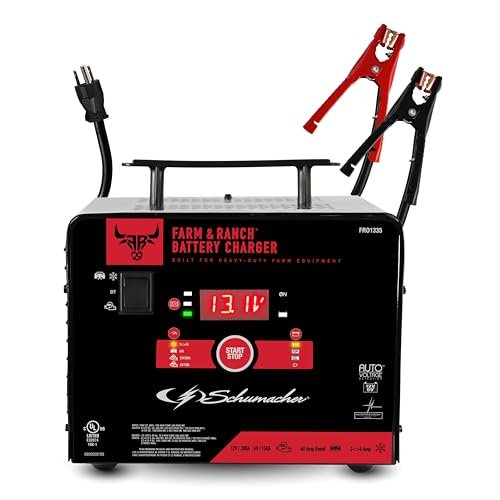
FR01335 keeps things plain, and that simplicity is the point. With 6V and 12V support and a 6-amp output, it fits the kind of maintenance work that happens in a normal garage, on a weekend car, or with a seasonal battery that needs attention between uses.
Compared with the SC1364 and the higher-output models above it, this Schumacher feels less ambitious and easier to live with. That lighter approach works well for casual upkeep, though it does not aim for the stronger recovery tools or the broader voltage range offered by the PCHH and E-FAST units.
Positives
- 6V and 12V support keeps it flexible for common household batteries.
- 6-amp output suits routine charging without feeling overbuilt.
- Simple setup makes it approachable for regular garage use.
- Compact maintenance focus works well for occasional charging chores.
Room For Improvement
- It is more about upkeep than stronger recovery work.
- Shoppers who need 24V support will want a different model.
- Those managing several battery chemistries may prefer a more flexible pick.
Feature Rundown
Perfect Match For
It suits drivers and hobbyists who want a straightforward charger for basic, repeatable maintenance.
Where Another Pick Fits Better
Clore Automotive PL2310 10-Amp Fully-Automatic Smart Charger 6V and 12V is the better move for anyone who wants temperature compensation and a little more charging muscle.
How To Choose The Right Automatic Battery Chargers
Match Voltage To The Vehicles You Keep
Voltage compatibility is the first filter. A 6V/12V charger fits older equipment and most cars, while a 12V/24V model makes more sense for mixed garages that include trucks or heavier machinery.
That matters because the wrong voltage range narrows your options before the charger even starts. A broader model costs more for a reason, but it also removes the need to keep separate units for separate jobs.
Think About Output As Time And Control
Amperage, meaning how much current the charger can deliver, shapes how fast it works and how gentle it feels. A 6-amp maintainer suits slow, steady upkeep, while 15 to 20 amps gives you more pace for recovery and larger batteries.
Higher output is handy in a busy garage, though it also tends to bring a larger body, more controls, or a little more learning. For a single weekend car, modest output often feels calmer and easier to store.
Look Closely At Charging Modes
Automatic shutoff, trickle mode, repair mode, and temperature compensation each solve a different problem. Trickle charging keeps a battery topped off, while temperature compensation adjusts charging behavior based on heat or cold, which matters in sheds, garages, and seasonal storage.
Mode-rich chargers suit people who keep vehicles for weeks at a time or rotate between bikes, cars, and lawn gear. Simpler chargers can still serve well, but they ask less of you and usually do less in return.
Things Worth Knowing First
Hidden Buying Traps
A common mistake is grabbing a charger for the vehicle you own today, then finding out it does not match the battery in the next garage project. Another is ignoring storage space, which matters more with wheeled units and larger housings.
Battery chemistry is the other easy miss. LiFePO4, AGM, and lead acid do not always behave the same, so a quick check of the charger’s supported types saves headaches later.
The Upgrade Payoff
Higher-tier chargers usually cost more because they add broader voltage support, more output control, and smarter charging stages. Those extras matter most in homes with multiple vehicles or batteries that sit unused for long stretches.
For a basic commuter car, a simpler model often does the job without much fuss. For mixed equipment, winter storage, or older batteries, paying more can mean fewer separate tools and a smoother routine.
Frequently Asked Questions
What makes an automatic battery charger different from a basic charger?
An automatic model monitors the charge process and changes behavior on its own. That makes it easier to use for routine maintenance and storage.
Do you need 6V support?
You need 6V support only for equipment built around that battery type, such as some classic vehicles or older machines. Most modern cars use 12V batteries, so many garages never need the lower setting.
Is a higher amp rating always better?
Not always, because higher output can be more than a small battery or simple upkeep job needs. The right level depends on whether you want steady maintenance or faster recovery.
What is temperature compensation?
Temperature compensation means the charger adjusts its behavior based on battery temperature. That helps in hot garages, cold sheds, and seasonal storage spaces.
Which charger suits mixed battery types?
A charger that lists both LiFePO4 and lead acid support is the safer starting point for mixed setups. The PZ.P and E-FAST models in this list fit that kind of use well.
Closing Thoughts
The best automatic battery chargers are the ones that fit your vehicles, your storage space, and how much control you want over charging. A simple 6A maintainer works nicely for one car, while 12V/24V smart models make more sense for mixed garages and heavier equipment. The Schumacher picks keep things familiar, the PCHH and E-FAST units bring more range, and the Clore option sits nicely in the middle. Choose the level that matches your routine, and the charger should feel useful rather than fussy.