
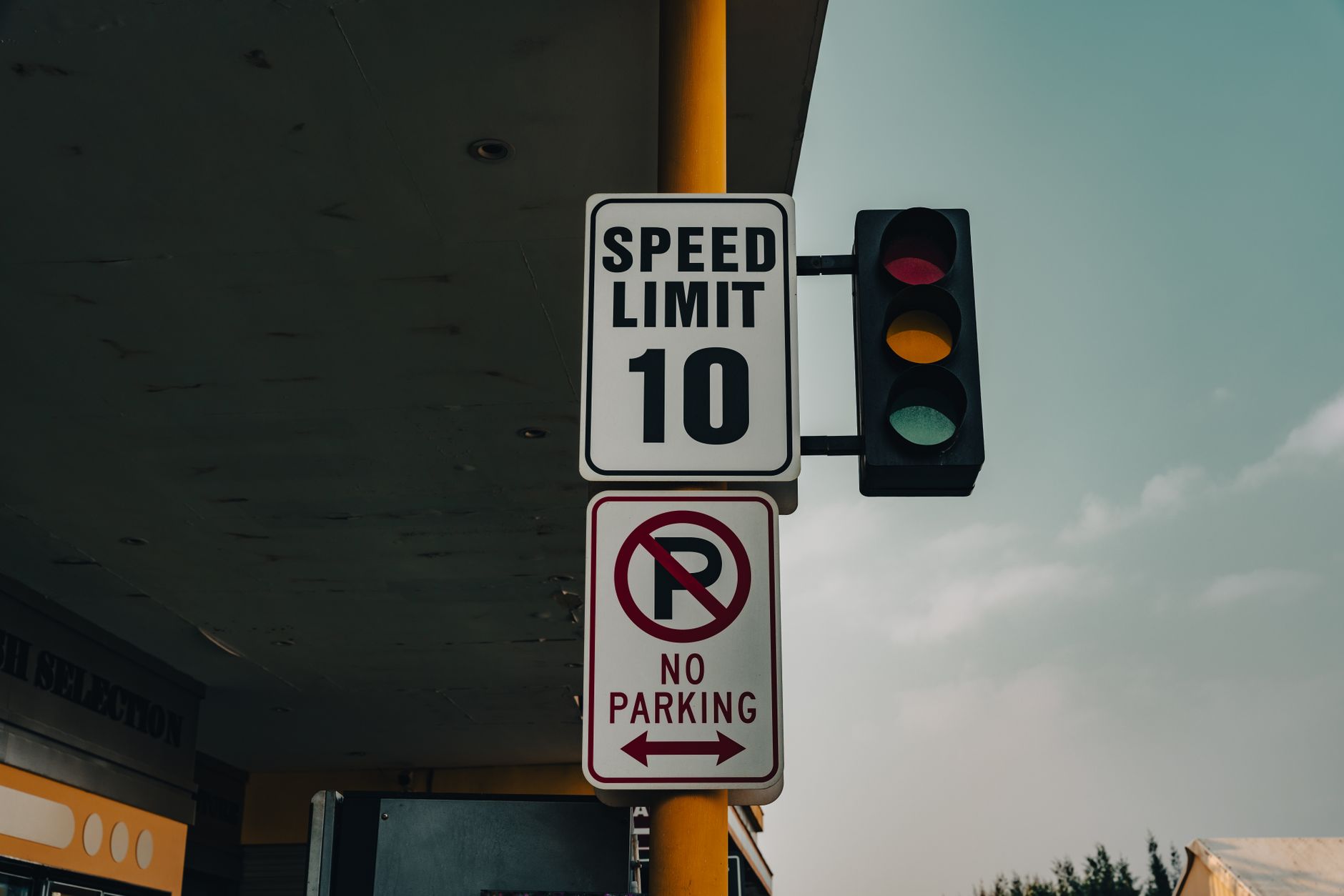

On many lots, the posted or legally enforced limit for low-speed driving on private or public parking property is usually much lower than the limit on the street. Most lots post 5, 10, or 15 mph because people walk through the area, carts move quickly, and backing space is tight.
This article covers the parking lot speed limit and the rules that shape it, including common sign-posted speeds, private-property authority, enforcement risks, and how advisory notices differ from binding limits.
Why Parking Lots Run Slower Than Streets
Shared space leaves less room to react, so low speed matters long before a crash seems likely. White lane paint, parked cars, and people on foot all squeeze the driving lane, and a car at 10 mph stops far more cleanly than one that drifts toward 20 mph.
That slower pace also cuts the chance of bumpers clipping carts or drivers missing someone stepping out from between vehicles. Garage ramps and enclosed decks need even more restraint because columns, blind corners, and hard walls leave almost no forgiveness.
Pedestrians, carts, and tight turns shape the limit
A grocery lot full of shoppers needs a different pace than an empty office lot. Add cart corrals, delivery trucks, and one-way aisles, and the safest number drops fast.
That setup is why the parking lot speed limit sits far below a road posted at 25 or 35 mph. Once people and cars share the same lane, steering room and braking room disappear quickly, and the next section shows the numbers you’ll usually see.
Garages demand even more caution
Concrete pillars block sight lines, and polished surfaces can throw glare right back into the driver’s eyes. A person stepping out of a side aisle can vanish for a second, so scanning has to stay wide and deliberate.
Sound does not help much either, because garages echo and compress noise. A tire squeal or horn may arrive too late, which is why low-speed driving in parking areas becomes a visibility problem before it becomes a speed problem, and the next section shows the numbers you will see most often.
Those limits vary by lot design, but their purpose is the same: keeping people moving safely at low speed.
Typical Posted Limits Across The United States
Most signs in the United States show 5 to 15 mph, with 10 mph as a common middle ground. Property layout, city rules, and the local traffic ordinance all shape the number you see.
The posted sign controls the pace, not a guess based on the road nearby. A 15 mph lot beside a 25 mph street still requires the lower speed, and that limit affects lane choice and braking distance.
| Posted limit | Where you may see it | Why it fits |
|---|---|---|
| 5 mph | Busy garages, hospital decks, school lots | Very short stopping space and heavy foot traffic |
| 10 mph | Retail centers, supermarkets, apartment lots | Balances flow with pedestrian safety |
| 15 mph | Larger open lots with clear aisles | More room, but still a low-speed driving zone |
That spread explains why two places in the same city can post different numbers and both be correct. A hotel driveway, a mall lot, and a municipal garage can all follow different local rules based on use, access, and visibility, so the next question is who actually has the power to set them.
That patchwork of rules depends on control of the land, which determines who can post and enforce a limit.
Who Sets The Rules On Private Property
Property owners and operators can set parking lot driving rules as long as they are posted and fit local law. A shopping center may use 10 mph while a warehouse yard uses 15 mph, since each site carries a different level of risk.
Private property is not the same as a public street
A public road follows city, county, or state law, but a lot behind a store belongs to the owner or manager. That difference matters because not every lot rule comes from the Department of Transportation or local police; the property operator can set the limit with signs and pavement markings.
A painted speed legend, a wall-mounted sign, or arrows on the pavement can all send the same message. Clear notice makes confusion harder to claim after a close call, and that leads straight into enforcement.
Signs and markings carry the message
Speed notices do not need to look fancy to work. Black lettering on white aluminum, stencil paint at the entrance, and yellow curb markings all do the same job: they show what the lot expects.
A cracked sign does not cancel the rule if the message is still readable. The safest move is to slow early, because property rules often matter before you even reach the first row of parked cars.
When the numbers are enforceable, ignoring them can invite fines, towing, or bigger liability after a crash.
Tickets, Enforcement, And Legal Exposure
Parking lot speeds can lead to tickets when the lot falls under traffic laws or a local traffic ordinance. Local police may issue a citation, and in some places the municipal code gives them clear authority to do so on privately owned lots open to public use.
Private security and property managers also enforce lot rules in non-criminal ways. They may issue warnings, remove access, or report repeat problems, even when no uniformed officer is present.
Police citations can still happen on private land
Private property does not always mean no enforcement. A lot open to public traffic can still fall under state law or local code, and a speeding ticket can follow the same basic process used on a street.
Arizona is a useful example because local rules can change from city to city. A Phoenix shopping center, a Tucson medical complex, and a suburban apartment lot may each post a different limit, and the sign at the entrance controls the next move.
Property managers use different tools
Security staff often focus on repeat behavior, near misses, and complaints from tenants or shoppers. They may document the plate, contact management, or restrict access to a garage key card system after repeated unsafe driving.
That process is civil rather than criminal, but it still has consequences. A warning from the property office can lead to towing or trespass action later, which is why unusual posted numbers matter when they are plainly visible.
The difference matters because some signs are only guidance, while others can trigger real penalties for drivers.
Advisory Signs Versus Enforceable Limits
Some signs are suggestions, while others act like a formal limit backed by traffic law. An advisory sign says slow down for safety, but a posted limit with clear speed signage can support a citation or property action.
The difference turns on wording and local authority. A sign that says “Drive slowly” gives caution, while “Speed limit 10 mph” reads as a rule, and the parking lot speed limit can matter even more when local police treat the lot as traffic-controlled space.
Advisory signs ask for caution
An advisory sign does not always create a stand-alone offense, but it still describes the risk. A narrow aisle beside a loading zone or crosswalk needs the same care whether the sign is advisory or formal.
The safest reading is simple: treat every advisory notice as a warning with teeth. The vehicle will not know the difference, and the pedestrian stepping out from behind an SUV certainly will not.
Formal limits carry legal weight
Clear limit language, entrance signs, and painted numbers can make the rule enforceable under parking lot traffic laws. A lot near a school, hospital, or transit center often uses this setup because the traffic mix changes fast and the risk rises with it.
Slow early at the entrance and hold that pace through the aisles. A hard brake in a lot often means the car behind you is already too close.
Once the sign type is clear, local law becomes the last piece, because state rules can change what happens after the sign goes up.
What happens after the sign appears depends on state law, and driving habits still shape everyday compliance.
State Rules And Everyday Driving Habits
Arizona shows why local law changes the answer from place to place. A posted limit in one city may be handled under a local traffic ordinance, while another city applies a different municipal code, so the lot sign and the local rule have to agree.
That means the posted number deserves attention every time you enter a new site. The same grocery chain can post 10 mph in one town and 15 mph in another, so the driving habit has to follow the sign in front of you.
Arizona shows how local law changes the picture
State law sets the broad legal frame, but cities often shape how parking lot driving is handled. Arizona drivers, for example, may see different enforcement levels in Phoenix, Mesa, Scottsdale, or Tucson, depending on the lot and the agency involved.
That local variation matters because a lot can look ordinary and still be governed by a specific traffic ordinance. A posted limit that seems low may still be the exact number the property chose for its own layout.
Daily habits keep you inside the limit
- Enter slowly, because the entrance is where pedestrians and turning cars mix first.
- Scan side aisles, since shoppers step out between parked vehicles with little warning.
- Leave extra space, so you can stop cleanly for carts, bikes, or a backing vehicle.
- Back with care, because mirrors miss low posts, curb stops, and small children.
- Turn wide only when clear, since tight turns reduce control in narrow lanes.
Those habits matter more than speed alone because parking lot traffic laws are built around real motion, not theory. A slow approach, steady scan, and careful backing keep you inside the posted number and away from the kind of scrape that ruins a normal errand.
Those habits matter because small choices in a lot often decide whether a routine stop stays trouble-free.
What To Remember
The safest answer is the posted sign in front of you, backed by local rules and the property owner’s notice. Most lots sit in the 5 to 15 mph range, but the exact number depends on the site, and a small mistake can still bring a ticket, a warning, or a crash.
FAQ
What is the speed limit in a parking lot?
It is the posted limit or local rule that applies to a specific lot, and it is usually 5 to 15 mph in the United States. The sign at the entrance, not your guess, tells you what speed the property expects.
Can you get a speeding ticket in a parking lot?
Yes. Local police can ticket you in some lots when state law, a traffic ordinance, or municipal code covers that property, and private managers can also take non-criminal action such as warnings or access restrictions.
How fast should you be going in a parking lot?
Drive at or below the posted number, and slow more in busy aisles, tight garages, and places with blind corners. Ten mph is common, but your exact pace should match the sign and the traffic around you.
What is the maximum speed in a parking lot?
There is no single national maximum. Some open lots post 15 mph, while garages, hospitals, and school areas may post 5 mph, and the enforceable number is the one clearly signed for that property.
Is the speed limit different in Arizona parking lots?
Yes, it can be. Arizona parking lots still follow posted signs and local rules, and city code can change enforcement from one place to another, so you need to check the sign each time you enter a new lot.