


Marine radio stereos need to do more than play audio. They have to fit a dash cleanly, handle salt-air exposure better than ordinary car units, and stay usable in bright, wet, vibrating conditions. The right unit depends on how the helm is laid out, whether streaming matters more than discs or broadcast radio, and how much control is needed while moving around the deck. That trade-off shows up fast in compact gauge-style centers, single-DIN receivers, and bundled speaker systems.
Quick Look At Our Top Picks

Sony DSXM55BT Marine Digital Media Stereo Receiver

Fusion MS-RA70 Stereo 4x50W 2-Zone
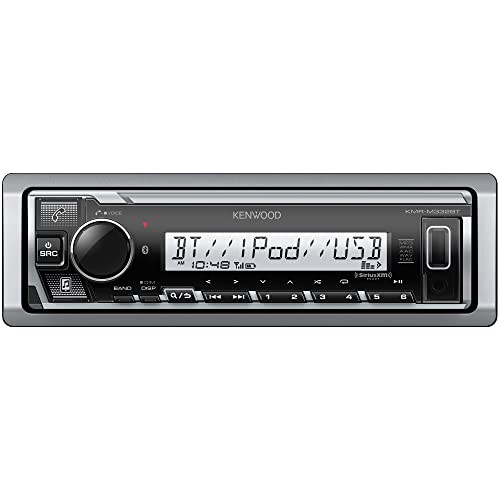
KENWOOD KMR-M332BT Single Din Marine Stereo

Kicker 46KMC2 Gauge-Style Media Center

Pyle Marine Radio Single DIN Receiver

BOSS Audio Systems MCK632WB.6 Marine Stereo and Speakers

KENWOOD KMR-D382BT Single Din Marine Stereo
More Details On Our Top Picks
Sony’s single-DIN layout suits helm stations that need a clean, familiar footprint. Bluetooth and NFC, or near-field communication, shorten phone pairing, while the front USB supports iOS and MTP devices for wired playback and charging duties. That mix makes sense for day-boating crews that want easy control without a bulky interface.
The honest read is that this pick leans into convenience rather than feature overload. It fits daily dock runs and casual cruising better than a setup that needs multi-zone audio or speaker bundles, which is exactly where the Fusion MS-RA70 starts to separate itself.
What We Like
- Bluetooth and NFC reduce setup friction at the helm.
- Front USB keeps media access close at hand.
- Single-DIN format works in many compact dash cutouts.
- Built-in microphone supports hands-free calling.
Points To Note
- Digital media focus means no CD slot for physical discs.
- The interface suits straightforward use more than complex cabin zoning.
- Front-panel ports deserve a little care in wet conditions.
Feature Snapshot
Who It Suits Best
Weekend boaters and daily marina commuters get the most from its simple control set and compact faceplate.
Where A Sibling Pick Shines
KENWOOD KMR-D382BT is the better match for owners who still want CD playback alongside Bluetooth and USB.
Fusion’s MS-RA70 looks built for boats where cockpit and cabin audio need different handling. The 2-zone layout lets separate areas behave differently, and the 4x50W output gives the receiver more headroom on paper than the simpler Sony DSXM55BT. For cruisers who spend time entertaining, that extra structure matters more than a minimal faceplate.
The Fusion Link app control adds flexibility, especially on boats where the helm is not always the only control point. One thing worth considering, though, is that this is more system-oriented than the most basic single-zone units, so it makes the most sense on rigs with a clear plan for separate listening areas.
Strong Points
- Two listening zones support mixed boat layouts.
- 4x50W output suits larger speaker plans.
- App control adds another way to manage playback.
- AM/FM, Bluetooth, and USB cover common sources.
- The layout suits shared boats where control needs to stay simple.
Small Caveats
- Zone control is more than many small boats need.
- App-based use can feel unnecessary for basic installs.
- Owners who prefer a very simple front panel may find it busier than the Sony unit.
Core Details
Built With In Mind
Boats with cockpit and cabin audio zones get the cleanest fit here, especially in family cruisers and dockside social setups.
Another Choice May Suit
SONY DSXM55BT is the simpler call for compact helm stations that only need straightforward streaming and USB access.
Kenwood’s KMR-M332BT brings a wider source mix than the leaner Sony and Fusion units above. Bluetooth, USB, Aux in, AM/FM, and SiriusXM Ready support give it a broad range of listening options, and the weatherproof build language points toward mixed-use boats or truck-and-boat setups. That versatility matters in real garages and marinas, where one head unit often has to cover more than one vehicle.
Multi-color illumination is a small touch, but it helps the face blend into different dash styles at night. The trade-off is straightforward, this unit asks for a little more setup attention than the most stripped-back options, yet it pays that back with more playback flexibility.
Bright Spots
- Bluetooth, USB, Aux, and AM/FM cover many source types.
- SiriusXM readiness adds another route for radio listening.
- Weatherproof construction suits mixed indoor and outdoor use.
- Multi-color lighting helps the dash feel integrated after dark.
- Single-DIN sizing keeps installation familiar for many rigs.
Room For Improvement
- The extra feature set can make setup feel busier than a simpler deck.
- Owners who only stream music may not need all the source options.
- Weatherproofing still calls for sensible care around spray and rinse cycles.
Technical Sheet
The Right Fit
Mixed-use owners who move between car audio and marine use get real value from the broader source support.
Swap It Out When
Pyle’s Marine Radio Single DIN Receiver suits a simpler budget install where basic streaming and playback matter more than layered source support.
The Kicker 46KMC2 is aimed squarely at open helms, where gauge-sized hardware and quick-glance controls matter. Its readable screen, rotary encoder, Bluetooth playback, USB and RCA inputs, plus AM/FM reception make it a flexible control point without a large footprint. The IPX66 rating is the key detail here, since that level of protection is built for harsh splash exposure rather than sheltered cabin use.
Compared with the single-DIN Sony and Kenwood options, this one is more about placement than source variety. The honest read is that it feels made for boats where a round dash opening is already part of the plan, and that very specific fit will be the main attraction.
Upsides
- Gauge-style body suits round dash openings.
- IPX66 rating supports exposed helm locations.
- Rotary encoder offers a simple tactile control feel.
- USB and RCA inputs widen connection options.
- Readable screen helps in bright outdoor settings.
Areas To Watch
- Gauge-format sizing narrows the installation match.
- Owners without an open-helm layout may not need this style.
- The compact design leaves less room for a broad front-panel interface than the Fusion unit.
Details At A Glance
Whose Shelf It Belongs On
Owners of center-console boats and open helms are the strongest fit, especially where a gauge opening already exists.
Look Elsewhere When
KENWOOD KMR-M332BT suits a more traditional single-DIN dash and gives broader source support for mixed-use setups.
Pyle keeps the formula straightforward, which is often the right move for a first marine stereo upgrade. Bluetooth streaming, AM/FM tuning, USB and AUX MP3 playback, hands-free calling, remote control, and RGB buttons cover the basic ownership needs without pushing into a more elaborate interface. For smaller runabouts and older dash layouts, that restraint can be a strength.
The splash-resistant framing helps it make sense in damp environments, although it still belongs in a system that gets sensible cover and regular wipe-downs. Compared with the Kicker 46KMC2, it is less specialized and easier to place in a standard opening, which makes the trade-off pretty clear.
Reasons To Buy
- Bluetooth and wired inputs cover common listening habits.
- Remote control adds convenience from another spot on the boat.
- RGB buttons help with nighttime visibility and styling.
- Single-DIN fit suits many familiar installations.
Minor Gripes
- The feature set is basic next to the Fusion and Kenwood units.
- Owners who want multi-zone control will need a different model.
- Splash resistance still calls for tidy cable routing and routine care.
Core Details
Right Fit
Entry-level owners and smaller boat setups get the most from its uncomplicated layout and broad everyday source support.
Skip It When
Fusion MS-RA70 is the better call for boats that need true two-zone control and a more system-oriented audio plan.
BOSS packages the head unit and 6.5-inch speakers together, which simplifies the shopping process for a fresh boat audio setup. The 50W x 4 output, AM/FM receiver, USB and aux inputs, multicolor illumination, detachable front panel, and included dipole antenna make it feel like a starter system with real installation structure. That bundle approach is handy in a boat refit where matching separate pieces can turn into a slow puzzle.
Compared with the standalone Pyle unit, this one asks for more room and more commitment, but it also covers more of the system at once. The detachable face adds a basic layer of security-minded convenience, and the package format will suit owners who want fewer separate purchase decisions.
Best Bits
- Head unit and speakers arrive together.
- 50W x 4 output supports a fuller setup.
- Detachable face panel adds everyday practicality.
- Multicolor illumination helps with nighttime dash matching.
- Included antenna removes one extra component from the list.
Softer Spots
- Bundle sizing may be more than a minimal helm needs.
- Shared packages can take a little more planning during installation.
- The included components make storage and mounting logistics more involved than a single receiver.
Feature Rundown
Perfect Match For
First-time marine audio setups and full refurbishments benefit from the bundled approach, especially on smaller recreational boats.
Where A Sibling Pick Shines
Pyle’s Marine Radio Single DIN Receiver is easier to slot into an existing dash when only a basic receiver replacement is needed.
Kenwood’s KMR-D382BT stands out for mixing older and newer playback habits in one receiver. Bluetooth, hands-free calling, CD playback, USB, AM/FM radio, and SiriusXM readiness give it a broad range that suits boaters who still keep discs around or want multiple listening paths. The all-weather in-dash design makes sense for rigs that split time between land and water.
Compared with the KMR-M332BT, this model adds the CD slot, so it serves owners with physical media still in rotation. That extra hardware makes the face less minimal, but for long-haul routes or older music libraries, the trade-off is easy to justify.
Positives
- CD playback adds support for physical media.
- Bluetooth and USB keep modern playback simple.
- Hands-free calling adds convenience at the helm.
- SiriusXM readiness broadens entertainment options.
- All-weather construction suits mixed-use vehicles and boats.
Honest Caveats
- CD hardware adds bulk compared with simpler digital units.
- Owners focused only on streaming may not use every source option.
- The richer front panel asks for a little more cleaning attention than the plainest receivers.
Key Specs
Who Should Grab It
Boaters who still use CDs, or who want a receiver that moves between vehicle and marine duty, are the clearest fit.
Reach For A Different Pick When
SONY DSXM55BT makes more sense for a simpler dash where Bluetooth and USB are enough.
How To Choose The Right Marine Radio Stereos
Match the unit to the helm first
Dash geometry sets the tone for the whole purchase. A single-DIN receiver, such as the Sony DSXM55BT or Kenwood KMR-M332BT, works in many standard openings, while the Kicker 46KMC2 is built for a gauge-size cutout that suits open-helm boats. That difference sounds small until installation day, because a clean physical fit often matters more than another feature on the box.
Decide how the boat will play music
Streaming dominates many casual setups, but source variety still matters on longer trips and shared boats. Bluetooth keeps phone playback easy, USB helps with direct device access, and AM/FM or SiriusXM Ready support gives backup options when signal or battery life becomes a concern. Disc playback, found on the KENWOOD KMR-D382BT, remains useful for owners with older libraries or vehicles that split marine and road duty.
Think in zones, not just watts
Power numbers tell only part of the story. The Fusion MS-RA70’s 2-zone layout matters because some boats need different volume levels in the cockpit and cabin, and the BOSS bundle shows how speaker pairing can simplify a first-time setup. Higher output can help with larger speaker plans, but zoning, control layout, and mounting style usually shape day-to-day satisfaction more than raw wattage alone.
Consider weather exposure and upkeep
Marine gear lives with spray, glare, and occasional grime, so the front panel should be easy to read and easy to clean. Splash-resistant or weatherproof language gives useful guidance, yet exposed helm positions still call for sensible placement and routine wipe-downs. In a boat that sits uncovered, a tighter control face and sturdier mounting style usually age better than a crowded, delicate layout.
What To Weigh Before You Buy
Common Shopping Slip Ups
A frequent mistake is choosing by features alone and ignoring the dash opening. A gauge-style unit and a single-DIN receiver solve different problems, so the mount type deserves the first look. Another misstep is overlooking how many people will use the stereo at once, because that changes whether a simple deck or a two-zone setup makes more sense.
The Upgrade Payoff
Higher-tier models usually cost more because they add control layers, broader source support, or bundled hardware. Fusion’s app control and two-zone handling, plus the BOSS package with speakers and antenna, show where extra money tends to go in this category. That upgrade pays off on larger boats, refits, or shared craft where convenience and system planning matter as much as the faceplate itself.
Frequently Asked Questions
Are marine radio stereos different from car stereos?
Marine units are built for wet, bright, vibration-heavy environments. Car stereos usually lack the same kind of water-oriented design focus.
Is Bluetooth enough for a boat stereo?
Bluetooth is enough for many casual boats and short outings. Longer trips often benefit from USB, AM/FM, or satellite-ready options as backup.
What is the advantage of a 2-zone marine stereo?
A 2-zone stereo lets different areas of the boat use separate volume settings. That helps on cruisers with a cockpit and cabin.
Do gauge-style marine stereos fit most boats?
Gauge-style units fit boats designed with round instrument openings. They are a poor match for standard single-DIN dash spaces.
Is bundled speaker hardware worth considering?
Bundled systems help simplify a first marine audio setup. They also reduce the guesswork of matching separate components.