
Keeping a boat battery topped off gets easier once you match the charger to the way you actually use your gear. Some setups call for a simple one-bank unit for a small skiff, while others need a two-bank onboard charger for a runabout with separate starting and trolling batteries. The picks below focus on waterproof builds, multi-battery coverage, and battery chemistries that show up on real docks and trailers.
You’ll also see a spread from compact smart chargers to heavier onboard models, so you can compare maintenance habits, mounting needs, and charge output without sorting through marketing fluff. That makes it easier to choose a charger that fits your storage space and your routine.
Quick Look At The Shortlist

Marine Battery Charger 5X1 1-Bank 5A Onboard Battery Charger

2 Bank Marine Battery Charger 5X2 10A 5A/Bank 12V Boat Charger

smart 2 Bank Marine Battery Charger 10A 5A/Bank 12V Waterproof

12V 2-Bank Onboard Battery Charger 10A 5A Per Channel IP68

NOCO GENIUS1 1A 6V/12V Smart Battery Charger
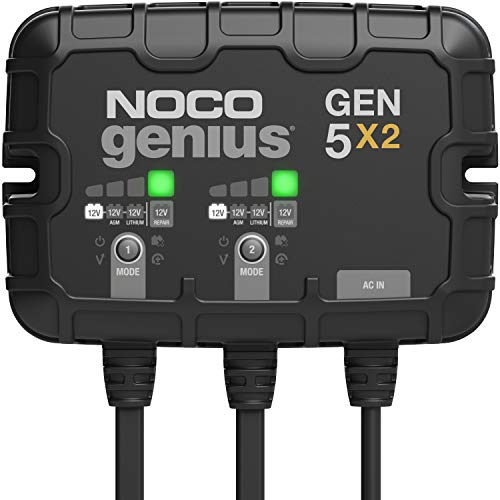
NOCO Genius GEN5X2 2-Bank 10A Onboard Battery Charger

NOCO Genius GENPRO10X1 1-Bank 10A Onboard Battery Charger
More Details On Our Top Picks
A one-bank charger like this keeps the setup straightforward, which suits smaller boats and weekend use. The 5A output per bank is modest, but that also keeps the profile simple for routine maintenance without a lot of clutter in the engine compartment.
Compared with the two-bank models later in the list, this FirstPower Pro unit makes more sense for a single battery boat or a backup charger you leave on board. The waterproof design and support for lead-acid and lithium chemistry give it a wider role than a basic garage charger.
Strong Points
- Single-bank layout keeps wiring easy to sort out in tight storage spaces.
- 5A charging suits a smaller battery that doesn’t need aggressive replenishment.
- Waterproof construction fits a damp bilge or exposed mounting spot better than a bare indoor charger.
- Support for lead-acid and lithium batteries broadens your setup options.
- Useful for routine upkeep on a boat that sits between outings.
Things To Consider
- One bank only, so it won’t cover a second battery on its own.
- 5A is steady rather than quick, so larger battery packs may ask for patience.
- Owners who store gear in cramped compartments may still want to check mounting space carefully.
Feature Snapshot
Who It Suits Best
You’ll get the most from this one if your boat runs a single 12V battery and you want a clean onboard install.
Where A Sibling Pick Shines
FirstPower Pro 2 Bank Marine Battery Charger 5X2 is the better match for a dual-battery boat that needs both banks covered.
This FirstPower Pro version steps up to two banks, so it fits boats where a starting battery and a house battery both need attention. The 5A-per-bank output keeps the pace controlled, which helps make sense for regular onboard use instead of quick bench charging.
You may find it especially sensible on a fishing boat or runabout that spends long stretches parked between outings. Compared with the single-bank 5X1, this one saves you from running separate chargers or rotating plugs around the deck.
What We Like
- Two-bank coverage handles a common dual-battery marine setup.
- 5A per bank spreads charging evenly across both batteries.
- Waterproof build suits mounting in boat compartments that see spray and humidity.
- Lead-acid and lithium support keeps it flexible for mixed ownership plans.
- Handy for boats that sit unused for stretches and need upkeep charging.
Minor Gripes
- Owners with a single battery may not need the extra bank.
- It’s a steadier charger, so you won’t get a rushed refill.
- More wiring than a compact portable charger means a slightly bigger install job.
Core Details
Made For
You’re the best match for this charger if your boat runs two batteries and you want both handled through one onboard unit.
Swap It Out When
NOCO Genius GEN5X2 suits you better if you want a more refined two-bank charger from a known marine-focused line.
The Zrfmib charger leans into battery care, not just basic power delivery. The maintainer and desulfator functions matter for boats that sit idle for stretches, since they add more attention to long-term battery condition than a plain charger usually does.
That broader chemistry fit is useful for mixed fleets with AGM, lithium, and deep-cycle batteries. Compared with the FirstPower Pro 2-bank unit above, this one looks more targeted toward owners who want a smarter battery care approach rather than a simple waterproof onboard charger.
Highlights
- Two-bank layout covers two batteries in one unit.
- Maintainer support helps suit storage-heavy ownership patterns.
- Desulfator function adds extra attention for battery upkeep.
- AGM, lithium, and deep-cycle support gives it broad compatibility.
- Waterproof design works well in damp marine spaces.
Points To Note
- The feature set is fuller, so setup may feel less barebones than a simple charger.
- Shoppers who only want basic single-battery charging may be paying for extras they never use.
- Any onboard install still deserves a careful look at mounting access and cable routing.
At A Glance
Best Suited To
You’ll appreciate this most if you keep a dual-battery boat and want maintainer features along with charging.
Look Elsewhere When
NOCO Genius GEN5X2 makes more sense for you if you want a more established two-bank marine charger with a cleaner product family.
Akizbeir takes a more detailed route with six-stage charging, which usually appeals to people who want the charger to handle the battery in steps instead of all at once. That six-stage approach can be reassuring in a boat, RV, or garage setup where the charger may stay connected for long periods.
It also stands out for IP68 waterproofing, a tougher ingress rating that points to strong dust and water resistance. Compared with the lighter FirstPower Pro picks, this one feels aimed at more demanding owners who want a charger that can sit in harsher spaces.
Upsides
- Two banks cover a pair of batteries from one unit.
- Six-stage charging gives a more controlled maintenance profile.
- IP68 waterproofing adds confidence for rougher mounting areas.
- Battery maintainer and desulfator roles widen its use on stored vehicles and boats.
- Compatible with AGM, lithium, and calcium batteries, which broadens fit.
Areas To Watch
- More advanced charging logic may be more than a casual user needs.
- It covers two batteries, so a single-battery setup won’t use the full package.
- Owners who keep the unit in a tight compartment may want to plan cable access early.
Details At A Glance
Built With In Mind
You’ll suit this charger best if your boat or RV lives in tougher conditions and you want a more managed onboard charging setup.
A Better Fit Elsewhere
FirstPower Pro 2 Bank Marine Battery Charger 5X2 makes sense for you if you want a simpler dual-bank option without the extra charging stages.
The NOCO GENIUS1 feels more like a maintenance tool than a heavy onboard marine charger, and that matters for smaller batteries or bench setups. The 1A output is slow by design, which makes sense for people who want gentle upkeep more than rapid recovery.
It also covers both 6V and 12V batteries, so it can move between a dinghy battery, a seasonal backup, or a battery stored beside the garage wall. Compared with the marine-focused two-bank models above, this one is far more portable and far less tied to an installed boat system.
Best Bits
- Very compact footprint suits a shelf, workbench, or storage bin.
- 6V and 12V support makes it more flexible than a marine-only unit.
- Automatic maintenance functions help with batteries that sit unused.
- Desulfator and temperature compensation add extra battery care features.
- Force Mode gives you a way to handle more stubborn charging situations.
Small Caveats
- 1A output is slow, so larger batteries can take patience.
- It suits bench charging more than a permanently mounted onboard setup.
- You may want a more marine-specific charger for dual-battery boats.
Feature Rundown
Right Fit For
You’re the right fit for this charger if you want a compact maintainer for smaller batteries or off-boat storage.
Where Another Pick Suits Better
NOCO Genius GEN5X2 suits you better if you want a stronger marine-mounted charger with two banks and a more permanent role.
This NOCO model sits in a sweet spot for boat owners who want two-bank coverage without stepping into a bulky system. The 5A-per-bank layout is steady, and the IP68 waterproofing makes sense for a charger that may live around spray, damp storage, or a washdown area.
Temperature compensation helps the charger adjust its behavior as conditions change, which can matter on boats stored outdoors or in seasonal climates. Compared with the FirstPower Pro 2-bank unit, this one feels more polished and more tailored to someone who wants a marine charger that blends in and keeps working quietly.
Bright Spots
- Two-bank charging handles a common dual-battery setup cleanly.
- 5A per bank gives balanced output for both batteries.
- IP68 waterproofing suits exposed marine environments.
- Temperature compensation helps the charger react to changing conditions.
- Lead-acid and lithium support makes it versatile for mixed battery fleets.
Worth Noting
- It still makes the most sense for users who need two banks.
- Owners who only need a spare maintainer may find it more charger than necessary.
- A permanent onboard install asks for neat cable routing and enough dry access.
Technical Sheet
The Right Fit
You’re in the right place with this one if you want a two-bank onboard charger that feels sorted for regular marine use.
Skip It When
NOCO Genius GENPRO10X1 is the better fit if you need a stronger single-bank charger rather than two-bank coverage.
The GENPRO10X1 is the most power-forward single-bank choice in this group, which makes it a fit for a lone 12V battery that benefits from stronger onboard charging. The 10A-per-bank output can be useful for boat owners who want quicker turnaround between outings without jumping to a multi-bank unit.
Its IP68 waterproofing and temperature compensation keep it firmly in marine territory, not just garage territory. Compared with the NOCO GENIUS1, this model is the step up for a larger single battery, while still staying simpler than the dual-bank GEN5X2.
Reasons To Buy
- 10A output gives more muscle than the smaller one-amp maintainer.
- Single-bank design keeps the install cleaner than a dual-bank system.
- IP68 waterproofing suits harsh boat environments.
- Temperature compensation helps it adapt to changing conditions.
- Lead-acid and lithium support broadens where you can use it.
Honest Caveats
- It only handles one battery, so dual-battery boats need a different pick.
- Owners with small batteries may not need the extra output.
- Like any onboard charger, mounting and cable routing deserve a careful plan.
Core Details
Whose Shelf It Belongs On
This charger fits you best if you want a strong one-bank onboard unit for a single battery boat or a dedicated maintenance setup.
A Better Fit Elsewhere
NOCO Genius GEN5X2 is the smarter choice if your boat needs two banks instead of higher output on one bank.
How To Choose The Right 12 Volt Marine Battery Chargers
Match Bank Count To Your Boat
Bank count is the first filter that saves time. A one-bank charger fits a single battery setup, while a two-bank charger works better on boats with separate starting and house batteries.
That choice matters more than flashy extras, because the wrong bank count creates awkward workarounds later. A compact skiff and a dual-battery fishing boat don’t need the same charger shape.
Think About Battery Chemistry And Output
Lead-acid covers a few common types, including AGM and gel, while lithium usually needs charger compatibility called out clearly on the listing. A charger that handles both battery families gives you more room to change gear later.
Output also changes the feel of ownership. A 1A maintainer suits slow upkeep, a 5A bank feels measured, and a 10A bank gives more charging muscle for a larger battery.
Look Closely At Water Resistance And Mounting
Marine chargers live near spray, humidity, and vibration, so waterproof construction matters in a way it doesn’t for a desk charger. IP68 means strong dust protection and a high level of water resistance, which is why it shows up on several higher-end picks here.
Mounting space matters just as much. A charger that fits neatly in a dry compartment is easier to live with than a larger box that crowds other gear or makes cable access awkward.
Choose Features That Fit Real Use
Maintainer and desulfator functions help the most when your boat sits for stretches between trips. Temperature compensation is also worth a look for boats stored in hot sun or cool sheds, because charging behavior can shift with the weather.
For casual use, a simple model may be enough. For regular boating, extra control often pays off in convenience and less fiddling around the dock.
What To Weigh Before You Move Forward
Common Shopping Slip Ups
One common mistake is picking output before bank count. A fast single-bank charger looks appealing, but it won’t help a dual-battery boat cover both batteries.
Another slip-up is overlooking battery type support. A charger that suits lead-acid may not be the right match for lithium, so the listing needs a careful read.
The Upgrade Payoff
Higher-tier chargers usually cost more because they add stronger waterproofing, more charging stages, smarter battery maintenance, and broader chemistry support. That extra detail matters most for boats that stay plugged in for long stretches or live in rougher storage conditions.
Spending up makes sense when your batteries are expensive, your boat sits outside, or you want fewer compromises in daily use. For a small boat that leaves the water occasionally, a simpler unit can still be enough.
Frequently Asked Questions
Can you use a marine battery charger on a car battery?
Some of these chargers support both marine and automotive use, but the compatibility list still needs to match your battery type. A two-bank onboard unit can be overkill for a simple car setup.
What does a maintainer do?
A maintainer keeps a battery topped off during storage instead of only pushing a quick charge. That makes it useful for boats that sit between weekends on the water.
Why does temperature compensation matter?
Temperature compensation helps charging behavior adapt to hotter or colder conditions. That matters in boats stored outdoors, where ambient changes can be dramatic.
Is IP68 worth paying attention to?
Yes, because it points to a stronger level of protection against dust and water. In a marine setting, that extra resilience can matter more than a plain indoor charger build.
Do you need two banks for every boat?
No, a single-battery boat can do well with one bank. Two banks become useful once your setup includes separate batteries that both need charging.
Final Thoughts
The right charger depends on your battery count, chemistry, and how often your boat sits between outings. The FirstPower Pro and NOCO options here cover different levels of simplicity, output, and protection, so you can match the charger to the way your boat actually lives. A compact maintainer suits a lighter setup, while a two-bank onboard model makes more sense for a busier rig. Choose the one that fits your storage space and your routine, and the rest gets much easier.